Child Reunification Considerations for Communities
| Site: | Pediatric Pandemic Network Learn |
| Course: | Child Reunification Considerations for Communities |
| Book: | Child Reunification Considerations for Communities |
| Printed by: | Guest user |
| Date: | Saturday, September 12, 2026, 3:15 PM |
Table of contents
- 1. Introduction – Protecting Children in a Disaster or Crisis
- 2. Planning Process
- 3. Identifying Needs of Children in the Community Prior to Disasters
- 4. Child-Specific Considerations
- 5. Raise Awareness, Communicate, Educate, and Drill
- 6. Operationalization of Reunification Practices for Children
- 7. Recovery: Transitioning from Reunification Operations to Post-Event Stabilization
- 8. Additional Resources
- 9. Acronyms
- 10. Definitions
- 11. Bibliography
- 12. Appendices
- 12.1. Appendix A: Child Reunification Planning Checklist and Worksheet
- 12.2. Appendix B: Community Stakeholders for Children Reunification Focus Group Worksheet
- 12.3. Appendix C: Identifying Gaps and Existing Elements in Child Reunification
- 12.4. Appendix D: Identifying Resources for Children Worksheet
- 12.5. Appendix E: Reunification Tips for Families
- 12.6. Appendix F: Integrating Unaccompanied Minor Scenarios in Reunification Training and Exercises
- 12.7. Appendix G: FRC ICS Organizational Chart
- 12.8. Appendix H: FRC ICS Child Reunification Group Supervisor Job Action Sheet
- 12.9. Appendix I: FRC Child-Focused Staff Job Action Sheet
- 12.10. Appendix J: Recommended Staff: Child Ratio and Group Size: Child Care Center
- 12.11. Appendix K: Guardian Registration Form
- 12.12. Appendix L: Child Intake Form
- 12.13. Appendix M: Reunification Pathway
- 12.14. Appendix N: FRC Safety & Security Checklist for Children
- 12.15. Appendix O: Call Center Script
- 12.16. Appendix P: Public Messaging Script Regarding Unaccompanied Minors
- 12.17. Appendix Q: FRC Child-Focused Resources for Staff
- 12.18. Appendix R: Guidance for Families Regarding Social Media
- 12.19. Appendix S: UMSA (Unaccompanied Minor Safe Areas) Location Assessment Tool
- 12.20. Appendix T: FRC Supply List for Children-Focused Operations
- 12.21. Appendix U: Mental Health Post-Disaster Resources for Children
- 12.22. Appendix V: Demobilization Criteria for Child-Focused Operations
- 12.23. Appendix W: Hot Wash and Debrief Guide – Child Operations
- 12.24. Appendix X: Child-Focused After-Action Report & Improvement Plan
- 12.25. Appendix Y: Additional Resources NCMEC
- 12.26. Appendix Z: Additional Resources I Love U Guys
1. Introduction – Protecting Children in a Disaster or Crisis
Family Reunification After Disasters

In the aftermath of disasters—including bus crashes, school shootings, and natural hazards - some children will be separated from their families or caregivers. Across the United States, millions of children spend weekdays away from their parents while attending school or receiving care in childcare facilities. Children may also become unaccompanied when a caregiver is injured during a disaster.
Reunification is complicated by the varied developmental, physiological, and psychological needs of children. Planning must account for differences in age, communication abilities, medical needs, functional needs, and responses to stress.
About This Toolkit
Suggested Citation
Blaser, B., Mazzara, R. L, Deutschmann, K., Chung, S., Lin, A. (2026). Child Reunification Considerations for Communities Toolkit. Pediatric Pandemic Network, Family Reunification Domain.
Many communities lack comprehensive plans tailored to the needs of children. To address this gap, the Pediatric Pandemic Network (PPN) collaborated with an interdisciplinary, multilevel task force of experts to create a specialized planning tool.
Drawing on lessons from previous disasters, this toolkit presents proven useful practices gathered from regional programs and children’s organizations dedicated to family reunification.
The goal of this toolkit is to support communities that are beginning family reunification planning as well as those seeking to strengthen existing plans. It serves as a practical guide to the unique needs of children that should be addressed through community emergency planning and preparedness.
1.1. Navigating This Toolkit
Overview
Welcome to this multimedia open access edition of the Child Reunification Considerations for Communities
This content is available as a digital toolkit in two formats:
1) Website, which you are currently reading. This format offers a mobile friendly multimedia experience with sharable links to chapters and subchapters. There are three ways to move through the toolkit:
a) Use the table of contents on the left to explore the toolkit. Scroll through the list and select a chapter or subchapter to view its content.
b) Use the yellow arrows that appear when scrolling to select previous and next chapters.

c) Use the previous chapter and next chapter buttons at the bottom of very page to navigate through the toolkit.

2) Printable, which you can save as a PDF and open without an Internet connection.
1.2. Acknowledgements
Acknowledgements
We gratefully acknowledge the following individuals who contributed to the development of this toolkit:
- Abby Bailey, MPA, NRP, Norton Children’s Hospital Hub Site/Pediatric Pandemic Network
- Brigitte French, CA-PEM, IAEM-CEM, DVM, UCSF Benioff Children’s Hospital/Pediatric Pandemic Network
- Nita Gupta, MD, Children’s Minnesota
- Ashley Liebre, MPH, Yale School of Medicine, Yale University
- David C. McCarthy, BA, NREMT (Ret), UCSF Benioff Children's Hospital/Pediatric Pandemic Network, Emergency Preparedness Solutions LLC
- Irene L. Navis, AICP, UCSF Benioff Children’s Hospital/Pediatric Pandemic Network, CBRN Domain
- Mike Peoples, American Red Cross
- Rebekah H. Reynosa, MS, CEM, MEP, CHEP, Intermountain Primary Children’s Hospital (2017–2024); Penn State Health (2024–Present)
- Alison Schonwald, MD, Touchstone Neurodevelopmental Center; Department of Pediatrics, Cambridge Health Alliance
- Joseph M. Urrea, CEM, MEP, Salt River Pima-Maricopa Indian Community Emergency Management
- Regina Yaskey, MD, Rainbow Babies and Children’s Hospital
- Joseph Zaydel, FEMA
Editors
- Brittni Blaser, MIHMEP, MoCEM II, Children’s Mercy Kansas City
- Rachel Mazzara, MPH, SSM Health Cardinal Glennon Children’s Hospital
- Kristy Deutschmann, BS, Pediatric Pandemic Network
- Sarita Chung, MD, Division of Emergency Medicine, Boston Children’s Hospital; Harvard Medical School
- Anna Lin, MD, FAAP, Stanford School of Medicine, Stanford Medicine Children’s Health
Pilot Organizations
We would also like to thank the organizations that helped pilot this toolkit. Their teams reviewed the content, provided valuable feedback, and implemented recommended best practices. We are extremely grateful for their contributions.
St. Louis Area Regional Response System
Pilot contact: Shelley Brandt

Massachusetts Department of Public Health
Pilot contacts: Tammy Goodhue and Benjamin Palmere
1.3. Overview
Purpose
This toolkit provides guidance for disaster management organizations and other groups involved in community reunification following a disaster. These guidelines do not replace existing plans. They are intended to strengthen those plans and ensure that new and existing plans address the needs of children.
Scope
Designed for planning sessions, training, and meetings, this toolkit addresses key considerations for safely and effectively reuniting children with their families, guardians, or caregivers.

The toolkit:
- Highlights children’s unique vulnerabilities and developmental needs.
- Promotes open communication among stakeholders.
- Helps communities identify gaps in preparedness.
- Offers practical strategies for creating safe spaces and protocols for unaccompanied minors.
Through practical guidance, promising practices, and examples drawn from real-world experiences, this toolkit equips communities with information and tools to protect vulnerable children during emergencies.
Communities can incorporate this material into Family Assistance Center plans, reunification plans, emergency operations plans, or other relevant planning documents.
Understanding This Toolkit
Community leaders, emergency responders, medical personnel, social service agencies, law enforcement personnel, and other stakeholders are encouraged to:
- Understand the unique challenges children face during disasters.
- Use data-informed tools to assess local child-specific needs.
- Engage openly with stakeholders to clarify roles and coordinate efforts.
- Apply relevant examples and promising practices from the toolkit.
- Adapt strategies to the community’s characteristics, needs, and available resources.
- Regularly review, exercise, and update plans to remain responsive to changing needs.
By applying these recommendations, communities can develop comprehensive, compassionate, and effective child-informed reunification plans that protect children’s safety and well-being during and after emergencies.
1.4. Background
Assumptions and Principles
This toolkit is based on the following assumptions and principles, which emphasize child-focused considerations during family reunification efforts:
- Immediate Family Inquiries: Following an incident, family members and friends are likely to contact or visit hospitals, schools, and other community facilities where they believe their loved ones, particularly unaccompanied minors, may have been taken. Facilities should prepare for a substantial influx of people seeking information, even when relatively few survivors have been located.
- Integrated Reunification Plans: Family reunification strategies cannot operate in isolation. Plans and procedures used by hospitals, schools, and other community facilities must be integrated with those of essential partner organizations, with particular attention to the unique needs of children.
- Safe Spaces for Children: Dedicated safe areas, particularly Unaccompanied Minor Safe Areas (UMSAs), are needed for children who do not have a guardian present. These spaces should provide appropriate safety measures and developmentally appropriate care until each child can be released to a verified custodial adult.
- Understanding Children’s Post-Disaster Behavior: Behavioral changes and stress-related physical symptoms are expected after a disaster. Health care providers, community workers, and caregivers should understand developmentally appropriate reactions, support adaptive coping, and identify children who may need additional intervention. This understanding can help mitigate long-term mental health effects.
- Expectations of Child-Focused Community Facilities: Families expect hospitals and other community facilities to identify affected children, including survivors and deceased victims; provide accurate and timely information; and assist with safe reunification.
- Delayed Victim Identification: Victim identification can be a prolonged process that may take days, weeks, or longer. The delay and resulting uncertainty can be especially difficult when children are involved. Families may struggle to understand the process, cope with ambiguity, and communicate effectively.
- Communication Challenges: Community facilities may be unable to meet families’ expectations for immediate information because of forensic requirements, incomplete information, or resource limitations. These challenges can be particularly distressing when children are involved.
- Child-Informed Cultural Responsiveness: Community facility staff should recognize how cultural traditions influence the ways families receive information, make decisions, and grieve, particularly when children are involved. Cultural humility is essential to providing effective, respectful, and compassionate support throughout the reunification process.
2. Planning Process
Building a Coordinated Community Response

Emergencies, particularly those involving children, require a localized and interconnected response. To effectively meet children’s needs following a large-scale emergency, communities must establish a strong foundation of trust, communication, and collaboration among response partners.
This foundation should be established before a disaster occurs through strong relationships among government agencies, nongovernmental organizations (NGOs), health care systems, schools, child-serving organizations, and private-sector partners.
Child-focused subject matter experts should be included in the earliest planning discussions. Their involvement helps communities identify the specialized capabilities, resources, safeguards, and developmental considerations needed when responding to children.
Start with Appendix A
Begin with Appendix A: Child Reunification Checklist and Worksheet. It provides key considerations for child-focused reunification planning and a baseline assessment of the capabilities in your community’s current plan.
2.1. Identify Key Stakeholders – Child Reunification Focus Group
Establishing a Child Reunification Focus Group
Begin by identifying key community stakeholders who can contribute to a focus group on child reunification. Agency representatives should demonstrate a commitment to child welfare and understand children’s developmental, behavioral, medical, and physiological needs.
When designating a lead agency, select an organization with reunification expertise, strong collaboration skills, and an understanding of children’s needs. Including stakeholders from multiple sectors gives the focus group access to a broad range of perspectives, expertise, capabilities, and resources.
Community Education Partners
| Who | Why |
|---|---|
| Community leaders with a personal stake in child welfare and the well-being of families | Provide guidance, mobilize resources, and promote collaboration |
| American Red Cross | Experience in setting up child-friendly reunification and shelter spaces, and planning support services |
| Department of Health and Human Services (HHS) | Expertise in child welfare, family services, and disaster response |
| Local health department | Knowledge of pediatric health care needs and pediatric community resources |
| Local children’s hospital / Pediatric health care professionals | Provide insight into the medical and developmental needs of children and guidance on trauma-informed care |
| Social services organizations | Experts in child welfare, casement, and family support services |
| Educational stakeholders | Schools, school districts, and other educational institutions can support academic needs including special education services and individualized learning plans |
| Emergency Medical Services for Children (EMSC) – State Partnership Program | Experts in pediatric emergency response, ensuring that medical services and resources are available and appropriately tailored to meet the unique needs of children |
| Early childhood education and childcare providers | Offer insight on age-appropriate care, child development, and early childhood education resources |
| Runaway and homeless youth programs | Provide perspectives on housing stability, family dynamics, and support services for this vulnerable population |
| Juvenile justice stakeholders | Provide insights on youth behavior, interventions, and the intersection between child welfare and juvenile justice systems |
| Youth recreational stakeholders | Identify positive youth engagement and skill building activities |
| Pediatric disability communities and organizations | Ensure that the unique needs of children with disabilities are considered throughout the reunification process, including access to appropriate services and accommodations |
Pediatric professional societies
|
Provide expertise in various fields related to pediatric care, emergency nursing, and child life services |
| United Way / Community foundations | Offer a broad network of community partners and resources that can aid in reunification planning efforts |
| Local universities and research institutions | Bring research-based insights and expertise in child development and family dynamics |
2.2. Assess Existing Local, State, and Regional Plans
Integrating Child Reunification into Existing Plans

Reuniting children with their families requires specialized expertise, detailed planning, and coordination among multiple organizations. A community may already have reunification plans, but those plans may address adults and children together or apply only to a particular jurisdiction, agency, adult medical center, or local hospital.
Child-specific reunification procedures should be integrated into these existing frameworks. This process requires careful alignment and, when necessary, revisions to current plans, policies, and operational procedures.
Emergency managers and stakeholders responsible for existing plans should participate throughout the integration process. Their involvement helps ensure that the community plan is comprehensive, operationally feasible, and capable of supporting a coordinated response for children and families.
2.3. Establish Clear Roles and Responsibilities
Defining Roles and Responsibilities

Clearly define the roles and responsibilities of each child-focused group member to ensure a coordinated effort centered on children’s needs. Assign team leaders or coordinators to oversee the reunification process, support accountability, and facilitate communication among stakeholders.

Key Responsibilities
- Assess the needs of children and families.
- Develop child-centered protocols and procedures.
- Provide specialized training and resources.
- Coordinate activities and information sharing among all agencies involved in reunification planning.
2.4. Foster Collaboration and Communication
Maintaining Communication and Collaboration

Encourage regular communication and collaboration across the broader community of child-serving organizations and caregivers. Relevant stakeholders may include:
- Faith-based organizations
- Foster care and congregate care agencies
- Children and families
- Hospitals and health care systems
- Schools and school districts
- Childcare and early childhood education providers
- Camps, scout programs, and youth recreation organizations
- Other local child-serving partners
Establish recurring meetings to review progress, exchange information, clarify responsibilities, and address challenges. Create an environment that supports open dialogue, active listening, and respect for different perspectives.
Use appropriate technology and communication platforms to support timely collaboration, particularly when team members are geographically dispersed. Establish backup communication methods in case primary systems are unavailable during an emergency.
2.5. Continuous Education and Training
Ongoing Education, Training, and Exercises

Ongoing education and training help planning team members remain informed about current research, promising practices, policies, procedures, and child-specific disaster considerations.
Planning team members should:
- Participate in relevant local training and disaster exercises.
- Conduct joint drills with hospitals, emergency management agencies, and other child-serving organizations.
- Practice incorporating children’s developmental, medical, behavioral, and functional needs into response procedures.
- Evaluate performance after each exercise and incorporate lessons learned into plans, procedures, and future training.
2.6. Evaluate and Adapt
Continuous Evaluation and Improvement

Regularly evaluate the Child Reunification Focus Group’s membership, capabilities, and areas of responsibility to identify missing components, resources, or subject matter expertise.
After drills, exercises, activations, and real-world incidents, review the reunification plan to confirm that it includes all essential child-focused considerations and capabilities.
Evaluation Activities
- Review focus group membership and identify missing subject matter experts.
- Assess whether the plan addresses children’s developmental, medical, behavioral, communication, accessibility, and safety needs.
- Gather feedback from team members, children and families, community organizations, and other stakeholders.
- Document strengths, gaps, corrective actions, responsible parties, and completion timelines.
- Update strategies, protocols, and training based on lessons learned and emerging promising practices.
3. Identifying Needs of Children in the Community Prior to Disasters
Understanding Children’s Needs

Effective reunification planning begins with a comprehensive understanding of the children and families within the community. During a disaster, existing medical, developmental, behavioral, communication, accessibility, and social needs may become more complex or difficult to address.
Communities should assess the demographics, needs, available resources, and potential scale and scope of a reunification event. This information can guide the development of targeted, responsive strategies that address children’s unique needs throughout the reunification process.
3.1. Collect Demographic Data
Coordinating and Collecting Child-Specific Data
Designate a primary child-focused point of contact responsible for coordinating the collection of information about children from:
- Shelters
- Family Assistance Centers
- Hospitals and health care facilities
- Childcare and educational facilities
- Coroner and medical examiner offices
- Other child-serving agencies
This individual should serve as the children’s liaison and coordinate information sharing and collaboration with the appropriate Emergency Support Functions.
Relevant Emergency Support Functions
- Emergency Support Function #6 (ESF #6): Coordinates mass care, emergency assistance, temporary housing, and human services, including sheltering, feeding, and support for family reunification.
- Emergency Support Function #8 (ESF #8): Coordinates public health and medical services, including behavioral health and fatality management support.
Assessing Community Demographics
Collect child-specific demographic information that can inform reunification planning, including:
- Age ranges
- Cultural backgrounds
- Languages spoken and communication needs
- Disabilities and access and functional needs
- Medical and behavioral health needs
- Transportation and housing considerations
- Other locally relevant factors
The following data sources are examples of resources that can help strengthen understanding of local needs.
Demographics Table
| Relevant Measures | Potential Data Source |
|---|---|
|
Region V for Kids Regional Metrics Scorecard |
|
Social Vulnerability Index |
|
Child Opportunity Index (COI) |
Additional Data-Collection Activities
- Collaborate with local government agencies, educational institutions, health care providers, and community organizations to access existing data or conduct surveys.
- Estimate the number and location of children in schools, childcare facilities, medical facilities, juvenile justice facilities, and other relevant settings during normal business hours and school days.
- Identify how child population patterns change during evenings, weekends, holidays, and seasonal events.
- Consider using Geographic Information System (GIS) technology to map and visualize child population data, community resources, hazards, and transportation needs.
3.2. Analyze Scale and Scope
Analyzing the Scale and Scope of Community Needs
Analyze the scale and scope of identified needs to understand the challenges children and families may face during reunification. Consider both current community conditions and how a large-scale emergency could increase or complicate those needs.

Key Areas for Analysis
- The number of children who may require reunification services.
- The prevalence of specific medical, behavioral, developmental, communication, or functional needs.
- The severity and urgency of identified challenges.
- Geographic concentrations of children and child-serving facilities.
- Existing gaps in services, staffing, equipment, transportation, or support.
- The capacity of current community resources to meet increased demand.
Use the findings to estimate the personnel, facilities, supplies, services, partnerships, and interventions needed to support safe and effective child reunification.
3.3. Prioritize and Develop Strategies
Prioritizing Needs and Developing an Action Plan

Use the collected data and stakeholder input to prioritize identified needs and develop targeted strategies. Consider the urgency and potential impact of each need, the number of children affected, and the consequences of leaving the need unaddressed.
Review available resources, existing programs, current capabilities, and opportunities for collaboration. Whenever possible, strengthen and connect existing systems instead of creating duplicative processes.
Action Plan Components
- Clearly defined priority need or planning gap
- Specific actions required to address the need
- Lead and supporting organizations
- Responsible individuals or teams
- Required personnel, funding, equipment, and other resources
- Target dates and implementation milestones
- Potential barriers and mitigation strategies
- Measures for evaluating progress and outcomes
- A process for reviewing and updating the action plan
4. Child-Specific Considerations
Planning for the Needs of All Children

Community reunification plans should address the distinct needs and challenges of the different child populations within the community. Planning should account for differences in age, development, health, disability, communication, culture, language, family structure, legal status, and access to resources.
4.1. Trusted “Safe Person”
Identifying a Trusted Safe Person or Entity
A trusted safe person or safe entity can play an important role in protecting children during reunification. This designation may refer to an authorized family member, close family friend, caregiver, trained professional, or child-serving organization capable of providing a secure and supportive environment.
Communities should establish standardized procedures for verifying the identity, authority, and suitability of any person or organization receiving a child. Procedures should comply with applicable laws, custody arrangements, agency policies, and child-protection requirements.

Key Considerations
- Verify the individual’s identity and authority to receive the child.
- Confirm the relationship between the individual and the child.
- Review available custody restrictions and protective orders.
- Complete required screening or vetting procedures.
- Confirm that the individual or entity can meet the child’s immediate safety, medical, developmental, communication, and emotional needs.
- Document the verification and release process.
4.2. Community Considerations
Identifying Community Resources and Partnerships
Community organizations can provide guidance, resources, advocacy, and direct support during reunification. Potential partners include local child welfare agencies, the Salvation Army, the American Red Cross, family support centers, and other nonprofit or community-based organizations.
Collaboration with these organizations can help families access the services and support needed to navigate the reunification process. Each organization’s role, authority, capabilities, and vetting requirements should be established before an emergency.

Key Resource Considerations
- Educational partnerships: Identify opportunities to collaborate with the Bureau of Indian Education, tribal school districts, public and private schools, charter and parochial schools, early childhood programs, and homeschool networks.
- Health care capacity: Assess the availability of pediatric primary care, emergency care, trauma services, behavioral health care, specialty care, urgent care, and hospital services.
- Emergency medical readiness: Assess whether emergency medical services personnel have pediatric-specific training, equipment, protocols, and medical direction.
- Child protective services and child welfare: Identify the agencies responsible for child protection, emergency placement, family support, and legal custody determinations.
Tribal Community Considerations
Planning should be conducted in partnership with tribal leadership and relevant tribal authorities. Additional considerations may include:
- Determining whether a tribal enrollment or membership office can assist with verifying registered members.
- Identifying the governing body or court with authority to determine legal custody of a child.
- Confirming whether the tribe has a designated child health, child welfare, emergency management, or family reunification leader.
- Identifying applicable tribal laws, customs, communication protocols, and data-sharing requirements.
4.3. Unique / Special Population Needs
Children with Disabilities and Children and Youth with Special Health Care Needs
Civil rights laws protect children with disabilities and support access to reasonable accommodations, health care, and specialized services. Community reunification plans should address the needs of children with disabilities and children and youth with special health care needs (CYSHCN).

Key Actions
- Maintain access to health care support, medications, treatments, and specialized services.
- Provide reasonable accommodations, including accessible transportation, medical equipment and supplies, mobility aids, and other assistive devices.
- Develop communication strategies tailored to each child’s language, developmental level, sensory needs, and preferred communication method.
- Create low-stress environments that account for sensory sensitivities and the need for quiet or reduced-stimulation spaces.
- Collaborate with caregivers and specialists familiar with the child’s disabilities, chronic health conditions, developmental needs, and established care plan.
- Plan for accessible toileting, feeding, refrigeration, charging, backup power, and safe storage of medications and equipment.
Children with Behavioral Health Needs
Before reunification, children may display a range of expected stress reactions, from emotional and behavioral changes to physical symptoms. Mental and behavioral health resources are important for supporting children’s well-being throughout the reunification process.
Key Considerations
- Traumatic experiences may increase a child’s need for reassurance, stability, and behavioral health support.
- Emotional distress and anxiety may require developmentally appropriate coping and regulation strategies.
- Loss and grief involving loved ones, homes, pets, belongings, or familiar surroundings should be acknowledged and addressed.
- Disruption of family, school, peer, and community support systems may affect a child’s adjustment and recovery.
- Children with persistent, severe, or escalating reactions may require additional assessment and referral to a qualified behavioral health professional.
5. Raise Awareness, Communicate, Educate, and Drill
Building Awareness and Understanding
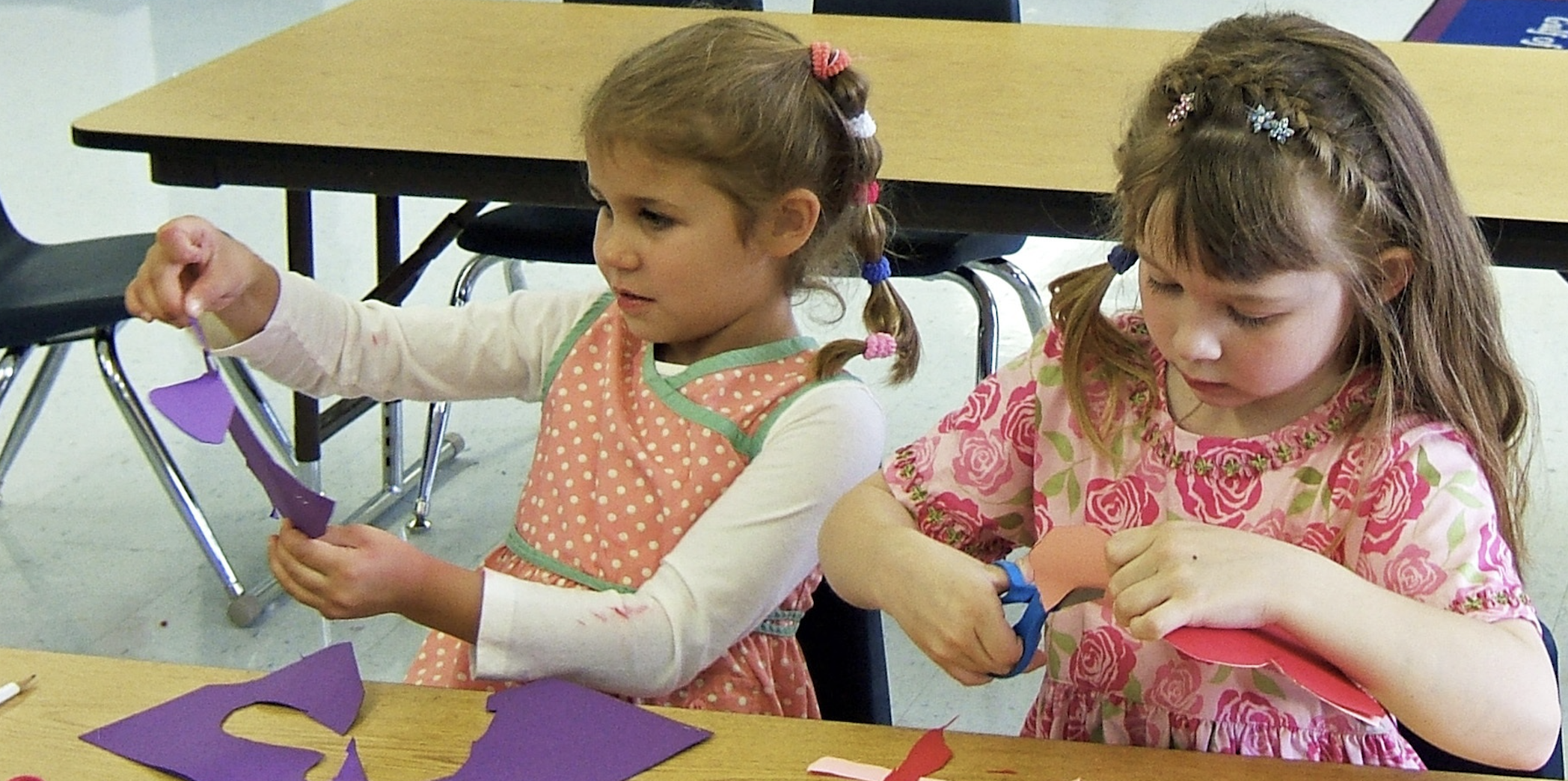
Community reunification planning should include education about child-specific considerations and how they affect reunification operations. All participating organizations should understand children’s unique needs during emergencies and the role each partner plays in supporting them.
Open, respectful conversations led by trusted child-focused professionals can uncover challenges that may not be apparent in written plans. Planning discussions should address practical factors such as:
- Appropriate staffing levels and staff qualifications
- Expected response and reunification timelines
- Child-focused facilities, supplies, and support services
- Developmentally appropriate communication
- Custody verification and child-release procedures
- Coordination with child-serving organizations
Addressing these factors supports collaborative planning that can adapt to the changing needs of children and families.
Community Education and Outreach
Child-focused preparedness can be strengthened through existing education and outreach programs. Communication methods and materials should be accessible to all families, including people with limited English proficiency and individuals with access and functional needs identified through community assessments.
Potential outreach partners include:
- Emergency management agencies
- Public health departments
- Schools serving students from prekindergarten through high school, including homeschool networks
- Childcare centers, preschools, and early childhood programs
- Foster care and child welfare agencies
- Community and family support centers
- Health care coalitions, hospitals, and health systems
- Law enforcement, fire services, and emergency medical services
- Traditional and social media organizations
Coordinating Public Messaging
Coordinated outreach is essential to educate the public and emergency responders about child reunification procedures. Engaging organizational leaders and public information or communication officers before an emergency helps ensure that messages are accurate, consistent, accessible, and trusted.
Integrating Children into Drills and Exercises
Community drills and exercises should include child-focused considerations. Scenario-based training allows partners to validate responsibilities, test coordination, and identify operational gaps involving:
- Unaccompanied minors
- Identity and custody verification
- Child supervision and safe-area operations
- Accessible and developmentally appropriate communication
- Children with disabilities or special health care needs
- Coordination with child welfare and other child-serving agencies
- Safe release and documentation procedures
After-action reviews should specifically evaluate these child-focused issues. Assign corrective actions, responsible parties, and completion timelines, and incorporate improvements into the reunification plan.
6. Operationalization of Reunification Practices for Children
Integrating Child-Focused Expertise into Incident Operations
This section provides guidance for integrating child-focused subject matter experts into the Incident Command System (ICS). It also identifies key components of Family Reunification Center (FRC) operations needed to support children’s safety, care, supervision, communication, and reunification.
6.1. Considerations for Children in the Community Family Reunification Center
Child-Focused Family Reunification Center Operations
Children of all ages must be considered in every aspect of Family Reunification Center (FRC) operations. This includes the physical layout, staffing model, registration, intake, tracking, reunification, release, and closure procedures.
Staffing and Volunteers

FRC staffing should account for the additional supervision and care children require. Staffing plans should use appropriate adult-to-child ratios based on children’s ages, developmental levels, disabilities, medical needs, and the complexity of the incident.
Staff and volunteers must be vetted according to applicable state and local safety, credentialing, and child-protection requirements. Screening may include:
- Identity and credential verification
- Criminal background checks
- Fingerprinting
- Child abuse and neglect registry checks
- Professional license or certification verification
- Other locally required screening
Emergency authorities may permit modified procedures under a disaster declaration. Even under emergency conditions, the responsible agencies should make every reasonable effort to verify the safety, suitability, and authority of individuals assigned to supervise children.
Registration
Accurate collection of information from parents, guardians, caregivers, and referring agencies is essential. Registration procedures should capture unique identifiers that support positive identification, matching, and custody verification.
Relevant documentation may include:
- Government-issued identification
- Child identification cards or school records
- Birth certificates
- Custody or guardianship documents
- Court orders or protective orders
- Medical or social service records
Intake of Unaccompanied Minors
Use a secure, developmentally appropriate intake area that is separate from public registration and reunification areas. Intake staff should:
- Document identifying information and the child’s place of origin.
- Take an identification photograph according to approved procedures.
- Assign a unique tracking identification number.
- Assess immediate medical, behavioral, developmental, communication, and access and functional needs.
- Document belongings, medications, equipment, and accompanying records.
- Arrange age- and need-appropriate supervision while keeping family and/or sibling groups together whenever safely possible.
Related resources:
Tracking
Assign each unaccompanied minor a unique tracking identifier at intake, such as a barcode wristband or numbered identification tag. The identifier should remain with the child and be used to document movement between authorized locations.
Tracking systems should be simple, secure, reliable, and capable of supporting clear handoffs among staff. Recommended data elements include:
- Wristband, barcode, or other unique identifier
- Place of origin, such as an incident site, shelter, or transport source
- Current status and location within the facility
- Time-stamped movement and staff handoff records
- Disposition information, including reunification or transfer details
- Photograph of the child for authorized visual identification
- Photograph of the potential caregiver, when permitted and appropriate, linked to the child’s record
- Caregiver identification and contact information
Safety and Security
Child-friendly spaces must be welcoming and physically secure. Monitor all entrances and exits, require staff and volunteers to display identification, and limit access to children to authorized and appropriately vetted personnel.
These areas may be located within a Family Assistance Center, FRC, or emergency shelter and may be operated by government staff, contracted childcare providers, or trained volunteers. Personnel should sign in and out and comply with facility access-control procedures.
- Prevent unauthorized access to child-care and intake areas.
- Do not permit unauthorized media access to children.
- Monitor and document all child movement and authorized transfers.
- Release children only through approved procedures after identity, authority, and custody have been verified.
- Coordinate disputed or uncertain cases with child welfare, law enforcement, legal counsel, or the court with jurisdiction, as required.
Communication and Information Sharing
Communication procedures should support timely, sensitive, and accurate information sharing about children. Staff should be trained to relay authorized updates about a child’s location, condition, and reunification status.
Information provided to families should be trauma-informed, developmentally appropriate, culturally responsive, accessible, and consistent with applicable privacy requirements.
Scripts and public messaging should explain:
- Where and how families can search for a child
- What information and documentation families will need to provide
- What families should expect during verification and reunification
- Why verification procedures are necessary for child safety
- How the public can support reunification without spreading misinformation
Matching and Verification
Use a structured, child-centered process to match unaccompanied minors with a custodial parent, legal guardian, caregiver, or other legally authorized adult. Verification should combine intake records, supporting documents, and visual or verbal confirmation.
Legal custody or other authority to receive the child should be verified before release. An established ethical and legal framework can support consistent decisions and reduce risk.
See the bibliography for the Region V for Kids Ethical Framework for Family Reunification and the WRAP-EM Legal Guide.
Identity Verification
- Interview the child for verbal or self-identification when developmentally appropriate.
- Use approved identifiers such as photographs, safe words, school records, medical records, and legally authorized biometric methods.
- Cross-check identity using birth certificates, custody orders, court documents, social service records, or other reliable documentation.
Matching Criteria
- Confirm the child’s legal custody arrangement before the disaster.
- Prioritize reunification with a verified parent or legal guardian unless a legal or safety barrier exists.
- If a parent or guardian is unavailable, consider another authorized relative or caregiver who presents sufficient legal documentation.
- Account for disabilities, special health care needs, and sibling relationships when making placement and reunification decisions.
Custody Verification
- Confirm custody through available court orders, custody agreements, guardianship records, and other authoritative documentation.
- When custody is disputed or unclear, maintain the child in an authorized safe placement and consult child welfare, law enforcement, legal counsel, or the court with jurisdiction.
- Address interstate jurisdictional issues under applicable law, including the Uniform Child Custody Jurisdiction and Enforcement Act (UCCJEA).
Chain-of-Custody Principles
- Document every authorized transfer, including the date, time, location, releasing staff member, and receiving individual.
- Use secure paper logs or electronic records.
- Maintain documented supervision and custody until reunification or an authorized transfer is complete.
- Do not release a child without documented verification and approval.
Sibling Reunification
Identify and reunite siblings together whenever safely and legally possible. Intake and registration forms should include prompts for sibling relationships. Staff should cross-reference this information throughout the matching process to prevent unnecessary separation and support emotional stability.
Special Circumstances
When a parent or guardian is deceased, incapacitated, missing, or otherwise unavailable, notify child protective services or the equivalent child welfare authority according to local procedures.
The responsible authority may:
- Arrange or assume temporary protective custody when legally authorized.
- Coordinate with law enforcement and FRC leadership.
- Verify guardianship and determine whether protective custody is needed.
- Arrange safe placement until an authorized caregiver is identified and verified.
Physical Space
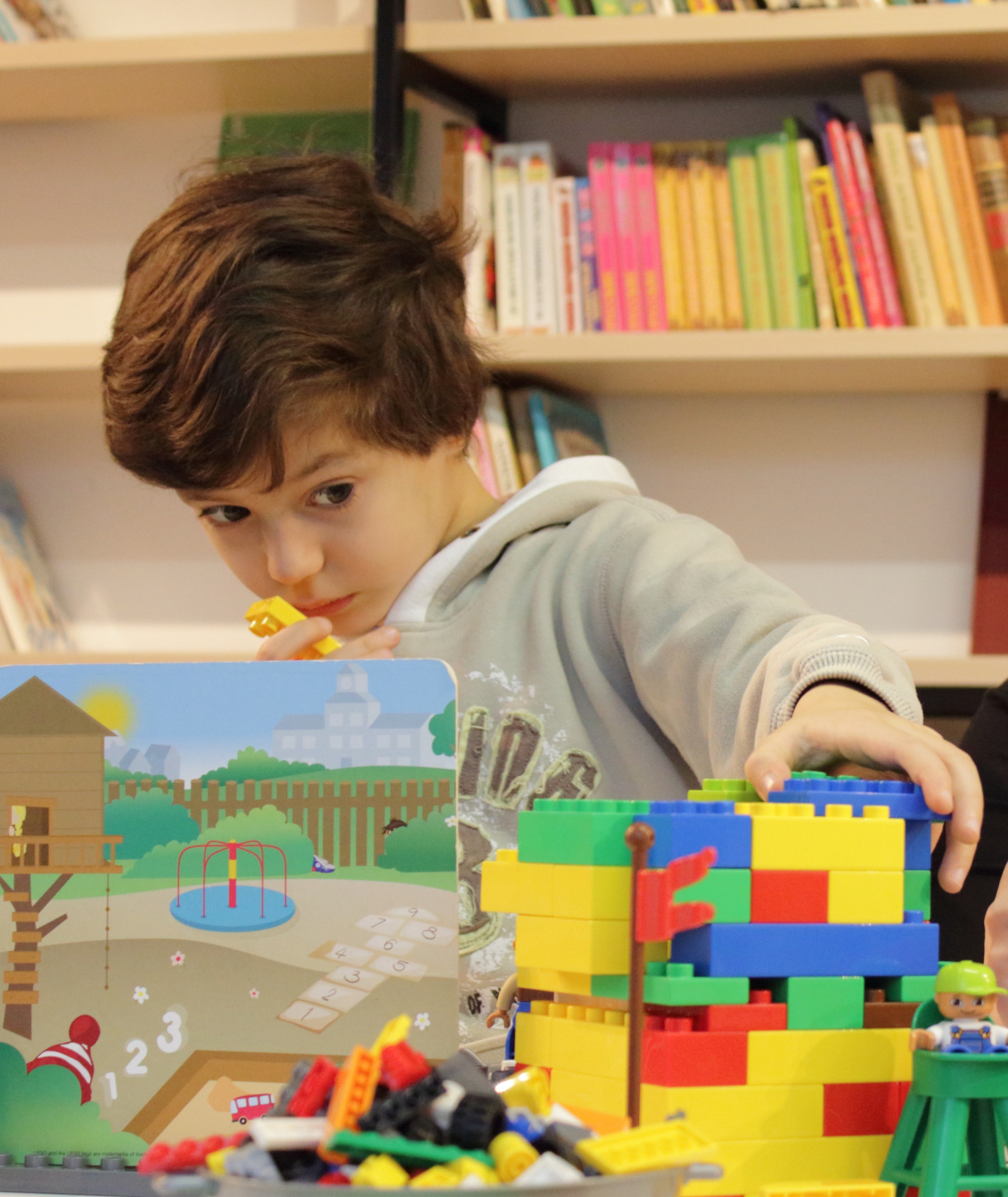
FRC design should account for children’s developmental, medical, behavioral, accessibility, and supervision needs. Provide age-appropriate waiting, intake, care, play, feeding, toileting, quiet, and reunification areas.
When operations span multiple locations, prioritize keeping family and sibling groups together whenever safely possible. This supports emotional security, simplifies verification, and reduces trauma caused by unnecessary separation.
Related resources:
- Appendix S: Unaccompanied Minor Safe Area Location Assessment Tool
- Appendix T: FRC Supply List for Child-Focused Operations
- Unaccompanied Minor Safe Area
- Reunification Area
Agreements with Partner Organizations
Establish written agreements with essential partners before an incident. Agreements should clarify roles, staffing, credentialing, resource support, information sharing, privacy protections, reimbursement, liability, and activation procedures.
Anticipatory Guidance for Families
Provide caregivers with follow-up information, behavioral health referrals, community resources, and developmentally appropriate educational materials to help children understand and process the event.
6.2. Operational Integration of Child-Focused Subject Matter Experts (SMEs)
Integrating Child Reunification into the Incident Command System
Within the Incident Command System (ICS) structure presented in this toolkit, the Family Reunification Center (FRC) and its related activities report through the Operations Section.
Communities can incorporate child-specific expertise into FRC operations using one of the following structures:
- Assign a child-focused subject matter expert to serve as a liaison to the FRC Supervisor.
- Establish a dedicated Child Reunification Group led by a Child Reunification Group Supervisor who reports to the FRC Supervisor.
The selected structure should be scalable to the incident and clearly documented within the community’s ICS organization, staffing plan, and operational procedures.
Operational Planning Resources
Appendix G: FRC ICS Organizational Chart provides a child-inclusive organizational structure for Family Reunification Center operations.
Appendix H: FRC ICS Child Reunification Group Supervisor Job Action Sheets describes child reunification responsibilities and integrates them into standard incident-response functions.
Section 7.0 identifies additional support resources, including community partners and organizations with specialized expertise that may assist with child reunification operations.
7. Recovery: Transitioning from Reunification Operations to Post-Event Stabilization
This section outlines recovery-phase operational guidance for reunification efforts involving children. Effective recovery planning ensures that the needs of children are not overlooked once immediate reunification activities conclude.
7.1. Demobilization of Child-Focused Reunification Resources
Demobilizing Child-Focused Operations
Decisions to scale down or demobilize child-focused resources at a Family Reunification Center (FRC) should be based on clearly defined operational criteria. Consider the number of children involved, their current needs, unresolved cases, available services, and the ability of receiving organizations to maintain safe continuity of care.
Child-Focused Demobilization Criteria
The following criteria should be evaluated together and adapted to the incident, jurisdiction, and needs of any children whose cases remain unresolved:
- Most unaccompanied minors have been accounted for and safely reunified with verified parents, guardians, caregivers, or other authorized custodial adults.
- No new child-related inquiries or registrations have been received during a locally designated period, such as 24–48 hours.
- Required identity, custody, and release verification processes have been completed and documented.
- Children not yet reunified have been safely transferred to authorized child welfare, health care, tribal, or other long-term support services.
- Child-specific tracking records have been reconciled, secured, and transferred or closed according to records-management procedures.
- Children have been offered appropriate behavioral health screening, immediate support, and referrals.
- Child-focused staff and subject matter experts agree that specialized on-site services can be reduced or transferred without compromising child safety or continuity of care.
Operational Recommendations
- Include the Child Reunification Group Supervisor or designated child-focused subject matter expert in FRC demobilization planning.
- Complete documentation and chain-of-custody procedures for every child who has not yet been reunified.
- Confirm that receiving organizations have accepted responsibility and possess the information, staffing, resources, and authority needed to continue care.
- Notify hospitals, child protective services, tribal partners, law enforcement agencies, schools, and other operational partners of demobilization timelines and transition procedures.
- Communicate closure or transition information to families and the public while protecting privacy and remaining sensitive to unresolved cases.
- Maintain a clearly identified point of contact for follow-up inquiries after the FRC closes.
7.2. Inclusion of Child-Focused Operations in Hot Wash and Debrief Activities
Capturing Child-Focused Feedback

Child-specific observations and feedback should be systematically captured during post-operational reviews. Findings should document strengths, challenges, unmet needs, and corrective actions related to child reunification operations.
Hot Wash: Immediately Following Operations
- Include response personnel, behavioral health staff, registration and intake staff, child advocates, and child-focused subject matter experts.
- Gather feedback about intake flow, identity and custody verification, tracking tools, handoffs, communication, supervision, and release procedures.
- Identify barriers experienced by children and families with additional needs, including children and youth with special health care needs (CYSHCN), children with disabilities, tribal children, and families with limited English proficiency.
- Document urgent issues that require immediate corrective action or follow-up.
Debrief: Within 1–2 Weeks
- Conduct dedicated child-operations breakout discussions, interviews, or surveys to gather more detailed feedback.
- Engage external child-serving partners, including hospitals, child protective services, schools, childcare providers, tribal liaisons, and behavioral health organizations.
- Review data, documentation, and unresolved cases to identify recurring issues and system-level gaps.
- Assign corrective actions, responsible organizations, and completion timelines.
7.3. Child-Focused After-Action Review and Plan Improvement
After-Action Reporting and Improvement Planning
The After-Action Report (AAR) and Improvement Plan (IP) should document child-focused findings and evidence-informed recommendations. This ensures that future reunification planning reflects lessons learned and remains responsive to children’s needs.
AAR and IP Actions
- Include a dedicated child-operations section or annex in the AAR.
- Document strengths, challenges, unmet needs, and observed outcomes related to children and families.
- Identify child-focused tools, partnerships, staffing models, resources, and training that were effective, insufficient, or unavailable.
- Translate findings into specific corrective actions with assigned owners, required resources, milestones, and completion dates.
- Update child-focused components of the reunification plan, standard operating procedures, training, job action sheets, and exercise materials.
- Reconvene the Child Reunification Focus Group to review findings, prioritize improvements, and revise protocols.
- Establish a process for monitoring corrective actions through completion and validating improvements during future exercises.
7.4. Mental Health and Psychosocial Recovery for Children and Families
Long-Term Recovery Support for Children and Families

Children and families may need support long after reunification occurs. Recovery planning should include trauma-informed follow-up, anticipatory guidance, resource navigation, and referrals to appropriate services.
Recommendations
- Provide caregivers with accessible printed and digital materials explaining common trauma reactions in children, warning signs that may require additional attention, and where to seek help.
- Coordinate authorized follow-up calls or outreach for children who received medical, behavioral health, or reunification support during the incident.
- Partner with schools, health care providers, child welfare agencies, and community organizations to support children’s post-event well-being and continuity of services.
- Provide families with information about developmentally appropriate behavioral health professionals, including providers trained in trauma, grief, and disaster-related stress.
- Ensure that materials and referrals are culturally responsive, accessible to people with disabilities, and available in the languages used by the affected community.
- Establish procedures for families to request additional assistance if symptoms emerge or intensify after initial recovery services end.
8. Additional Resources
Child Reunification Resources
This section provides a curated collection of local, state, tribal, and national resources that support child-specific reunification planning, response, and recovery. The tools and organizations represent multiple disciplines and can help communities strengthen planning, operations, training, and family support.
Although the collection is not exhaustive, it provides a foundation for identifying partners, evaluating available capabilities, and integrating child-focused expertise into community reunification strategies.
8.1. Safety and Security Resources for Missing Children and Unaccompanied Minors
Missing Children, Custody, and Reunification Resources
The following organizations and services can support the identification, custody verification, and reunification of missing children and unaccompanied minors while protecting children’s safety and legal rights.
Law Enforcement and Local Courts
Law enforcement agencies and courts may support missing-child investigations, identity verification, custody determinations, protective orders, and the lawful release or placement of children.
National Center for Missing & Exploited Children (NCMEC)
24/7 Call Center: 800-THE-LOST (1-800-843-5678)
NCMEC resources and services include:
- National Emergency Child Locator Center
- Field resources and Team Adam
- Case management
- Missing-child poster creation and distribution
- Analytical support
- Specialized forensic services
- Unaccompanied Minors Registry for disaster-related incidents
- Reunification and crisis-intervention support
Child Welfare and Child Protective Services
Child welfare and child protective services agencies may assist with custody verification, protective placement, family assessment, legal coordination, and safe care for children who cannot be immediately reunited with an authorized caregiver.
8.2. Public Assistance, Information Gathering, and Dissemination Resources
Information Collection and Public Communication
These resources support the collection, validation, and timely sharing of accurate information. Effective communication can help locate children and families, support reunification, reduce misinformation, and keep the public informed throughout operations.
Public Information Officers
- Coordinate consistent messaging across participating organizations.
- Verify information before public release.
- Monitor misinformation and coordinate rumor-control activities.
- Provide accessible, culturally responsive, and multilingual information.
Child-Serving Organizations
The following organizations may hold information that supports child identification, location, and family matching:
- Schools and school districts
- Childcare facilities and preschools
- Community and family support centers
- Independent youth, recreation, camp, and scout programs
Family Assistance Center Communication Resources
Family Assistance Centers may use multiple communication channels to receive inquiries and provide verified information, including:
- 2-1-1 or another designated community information service
- A dedicated call center or hotline
- A dedicated, accessible website
- Approved text-message or notification systems
Media and Social Media
Local media and approved social media channels can distribute reunification information quickly. Their use should be coordinated through established public-information procedures.
Social Media Considerations
- Protect children’s and families’ privacy.
- Align messaging with local reunification procedures and applicable legal requirements.
- Maintain ethical information-sharing practices during disasters.
- Avoid publishing identifying information or images unless release is authorized through approved procedures.
- Direct families to verified information sources and discourage the spread of unconfirmed information.
8.3. Physical Pediatric Health Resources
Pediatric Health Care Resources
Pediatric health care resources help ensure that children receive developmentally appropriate medical assessment, treatment, medication support, specialty consultation, and continuity of care throughout the reunification process.
Potential partners include:
- Children’s hospitals
- Community hospitals with pediatric capabilities
- Pediatric urgent care facilities
- Pediatric primary care and specialty clinics
- Pediatric rehabilitation centers
- Emergency Medical Services for Children (EMSC)
- Pediatric subject matter experts from health care coalitions
8.4. Disaster Mental Health
Behavioral Health Resources
Behavioral health resources can address the immediate and long-term needs of children affected by disasters, traumatic events, or separation from their families.
National Alliance on Mental Illness (NAMI)
- Mental health education and family support resources
- Information about finding local crisis and behavioral health services
- Connections to NAMI state organizations and local affiliates
- Community information about mobile crisis teams, where available
Substance Abuse and Mental Health Services Administration (SAMHSA)
- Guidance for supporting children and youth during and after disasters
- Disaster behavioral health information for families, responders, and community organizations
- Psychological First Aid resources for professionals working with children and adolescents
National Child Traumatic Stress Network (NCTSN)
NCTSN provides trauma-informed resources for children affected by disasters, abuse, accidents, violence, and other traumatic experiences.
Available tools include:
- Post-disaster guidance for parents and caregivers
- Child and adolescent trauma screening and assessment resources
- Guidance for schools, childcare programs, health care providers, and community organizations
- Online training for clinicians, first responders, and child-serving professionals
- Psychological First Aid resources
8.5. Non-Government Organizations
Voluntary, Community, and Private-Sector Partners
Voluntary organizations, community groups, charitable organizations, and private-sector partners can provide personnel, facilities, supplies, family-support services, and other resources during child reunification operations.
National and Regional Disaster Organizations
- American Red Cross
- National Voluntary Organizations Active in Disaster
- State and Territory VOADs and Community Organizations Active in Disaster
Potential Community Partners
- Charitable and private-sector organizations: Businesses, foundations, and nonprofit organizations that can contribute funding, facilities, supplies, transportation, technology, or personnel.
- Faith-based organizations: Congregations, Jewish community centers, Knights of Columbus councils, and other faith-affiliated service organizations.
- Education-based organizations: Parent-teacher organizations, National Honor Society chapters, Key Clubs, alumni groups, and other school-affiliated organizations.
- Community-based organizations: Youth sports leagues, recreation associations, activity clubs, neighborhood groups, and family support organizations.
- Volunteer service organizations: Shriners, Veterans of Foreign Wars posts, civic clubs, and other organized volunteer groups.
9. Acronyms
| AAR | After-Action Report |
| AMC | Adult Medical Centers |
| CA | Project Camp |
| COAD | Community Organizations Active in Disasters |
| CPS | Child Protective Services |
| CYSHCN | Children and Youth with Special Health Care Needs |
| DTAC | Disaster Technical Assistance Center |
| EMS | Emergency Medical Services |
| EMSC | Emergency Medical Services for Children |
| ESF | Emergency Support Function |
| FAC | Family Assistance Center |
| FRC | Family Reunification Center |
| GIS | Geographic Information System |
| HHS | Health and Human Services |
| HRSA | Health Resources and Services Administration |
| ICS | Incident Command Structure |
| ID | Identification |
| IP | Improvement Plan |
| JAS | Job Action Sheet |
| MCT | Mobile Crisis Team |
| NAMI | National Alliance on Mental Illness |
| NCMEC | National Center for Missing and Exploited Children |
| NCTSN | National Child Traumatic Stress Network |
| NECLC | National Emergency Child Locator Center |
| NGO | Non-Government Organization |
| PFA | Psychological First Aid |
| SAMHSA | Substance Abuse and Mental Health Services Administration |
| SME | Subject Matter Expert |
| UMDR | Unaccompanied Minors Disaster Registry |
| UMR | Unaccompanied Minors Registry |
| UMSA | Unaccompanied Minor Safe Area |
| VFW | Veterans of Foreign War |
| VOAD | Voluntary Organizations Active in Disasters |
10. Definitions
| Term | Definition |
| Child Life Specialist | A trained professional who helps children cope with hospitalization, illness, or traumatic events through play, education, and emotional support |
| Child Welfare Champion | A designated professional or liaison who advocates for and ensures that child-specific needs are addressed in all response and recovery operations |
| Custodial (Guardian, Parent, Caretaker) | An individual who has legal responsibility for the care and custody of a child. This may include a parent, legal guardian, or other caretaker formally recognized by the court or child welfare system. |
| Custody Verification | The process of confirming legal authority for an adult to assume responsibility for a child, using documentation, interviews, and official records |
| Disaster | A serious disruption that causes widespread damage, hardship, or loss of life. Disasters typically exceed the capacity of a community to respond and recover with local resources alone, requiring outside assistance. |
| Emergency | An event or situation that poses an immediate risk to health, life, property, or the environment and requires prompt action. Emergencies may be managed with local resources and do not always escalate to the level of a disaster. |
| ESF #6 (Emergency Support Function #6 | Mass Care, Emergency Assistance, Housing, and Human Services) – A federal coordination function that includes shelter, food, and family reunification services during disasters |
| ESF #8 (Emergency Support Function #8 | Public Health and Medical Services) – A federal coordination function supporting public health, medical care, mental health, and mortuary services during disasters |
| Family Reunification Center (FRC) | A designated site for registering, sheltering, and reunifying children and their families or guardians during or after a disaster |
| Guardian Registration | The formal process of documenting the identifying and custodial information for adults claiming a child during reunification operations |
| Incident | Any occurrence, natural or human-caused, that requires a response. Incidents are the broadest category and can range from routine (e.g., a car accident requiring EMS) to complex events (e.g., acts of terrorism, major disasters). |
| Intake | The initial process of recording a child’s identifying, medical, and situational information upon arrival at the FRC |
| Juvenile | A person under the age of 18 who is not legally considered an adult. The term is often used in legal, justice, or protective services settings. |
| Psychological First Aid | An evidence-informed approach for supporting people during crisis, reducing distress, and promoting adaptive functioning |
| PsyStart | A rapid mental health triage system used in disasters to quickly assess psychological impact and prioritize individuals for follow-up support or intervention |
| Reunification | The process of safely reconnecting children with their custodial guardians following separation due to an emergency, disaster, or other incident. Reunification prioritizes verification of custodial authority and the well-being of the child. |
| Safe Person/Entity | An individual or organization designated and trusted to provide temporary care, supervision, or protection for a child until reunification with their custodial guardian can occur. This may include vetted staff, volunteers, law enforcement, child welfare agencies, or other authorized entities. |
| Trauma-Informed Care | Service delivery that recognizes and responds to the effects of trauma to avoid re-traumatization |
| Unaccompanied Minor | A child under the age of 18 who is separated from their parent, guardian, or legally responsible caregiver during an incident |
| Youth | A young person generally between the ages of 12 and 17. The specific age range may vary by program, jurisdiction, or context. |
11. Bibliography
- American Academy of Pediatrics, American College of Emergency Physicians, Emergency Nurses Association, National Association of EMS Physicians, National Association of EMTs, Emergency Medical Services for Children (EMSC). Prehospital Pediatric Readiness Project Checklist.
- Academy of Pediatrics (AAP), American Public Health Association, National Resource Center for Health and Safety in Child Care and Early Education. Childcare.gov. Ratios and Group Sizes: Day Care Ratio Recommendations.
- American Academy of Pediatrics (AAP), Massachusetts General Hospital Center for Disaster Medicine. Pediatric Reunification Toolkit: Family Reunification Following Disasters – A Planning Tool for Health Care Facilities. 2018.
- American Academy of Pediatrics (AAP). Participation of Children and Adolescents in Live Crisis Drills and Exercises. Pediatrics. 2020;146(3):e2020015503.
- American Academy of Pediatrics (AAP). Pediatric Tabletop Exercise Resource Kit.
- American Academy of Pediatrics. Talking With Children About Disasters. HealthyChildren.org.
- American Red cross. Helping Children Cope with Disaster.
- Autism Behavior Services, Inc. Social Stories.
- Autism Little Learners. Social Stories for School.
- Brumberg EH, Chung S. Reuniting with your child after a disaster: 10 planning tips. American Academy of Pediatrics. HealthyChildren.org.
- Centers for Disease Control and Prevention (U.S.) (2015). Backpack emergency card.
- Children’s Mercy Kansas City. Child Intake Form.
- Children’s Mercy Kansas City. Guardian Registration Form.
- Children’s Mercy Kansas City. Helping Kids Navigate After a Tragedy.
- Children’s Mercy Kansas City. Reunification Tabletop Exercise Materials.
- Federal Emergency Management Agency (FEMA). Youth and Emergency Planning.
- National Center for Missing and Exploited Children (NCMEC).
- Ready.gov. Ready Kids.
- Ready.gov. Coping with Disaster for Kids.
- Region V for Kids. Ethical Framework for Family Reunification
- Region V for Kids. Family Reunification
- Region V for Kids. Regional Metrics Scorecard.
- Substance Abuse and Mental Health Services Administration (SAMHSA) Disaster Technical Assistance Center (DTAC).
- TherapyWorks. Why & How to Use Visual Schedules.
- Western Regional Alliance for Pediatric Emergency Management. Legal Resource Guide
12. Appendices
The list below provides an overview of the appendices included in this toolkit. Each appendix offers tools, templates, guidance, or reference materials to assist communities in planning, operating, and evaluating child-focused reunification efforts.
- Appendix A: Child Reunification Planning Checklist and Worksheet
Provides a structured framework to ensure the needs of children are fully integrated into reunification planning. - Appendix B: Community Stakeholders for Child Reunification Focus Group Worksheet
Helps identify and organize key community stakeholders involved in child reunification planning. Supports the formation of a focus group to ensure coordinated, child-focused preparedness and response. - Appendix C: Identifying Gaps and Existing Elements in Child Reunification
Supports review of local, regional, or state reunification plans with a focus on children. Offers a method to assess child-specific plan elements and identify actionable improvements. - Appendix D: Identifying Resources for Children Worksheet
Guides communities in identifying and coordinating specific resources for children, capturing capacity, gaps, and planning needs across multiple sectors. - Appendix E: Reunification Tips for Families
Tips for families to prepare for emergencies and reduce separation time during reunification efforts. - Appendix F: Integrating Unaccompanied Minors Scenarios in Reunification Training and Exercises
Safety guidance and tools (scenarios, player cards) for including unaccompanied minors in preparedness exercises. - Appendix G: FRC ICS Organizational Chart
Shows how child-focused staff fit into the Family Reunification Center (FRC) Incident Command Structure to support children’s needs. - Appendix H: FRC ICS Child Reunification Group Supervisor Job Action Sheet
Provides guidance for the supervisor in coordinating child-focused reunification activities. - Appendix I: FRC Child-Focused Staff Job Action Sheet
Guides staff in supporting safe and efficient reunification of children with guardians within the FRC. - Appendix J: Recommended Staff: Child Ratio and Group Size: Child Care Center
General guidance on staff-to-child ratios and group sizes, with reference to state and territorial licensing requirements. - Appendix K: Guardian Registration Form
Template to collect essential information from guardians during a response. - Appendix L: Child Intake Form
Template to collect identifying information for unaccompanied minors at the FRC. - Appendix M: Reunification Pathway
Flowchart illustrating operational steps for reunification efforts involving unaccompanied minors. - Appendix N: FRC Safety & Security Checklist for Children
Checklist to ensure all areas where children may be present meet physical and emotional safety standards. - Appendix O: Call Center Script
Sample script for call line staff assisting parents or guardians in reporting or locating children. - Appendix P: Public Messaging Scripts Regarding Unaccompanied Minors
Sample messaging for public communication after a disaster, adaptable for press releases, social media, and websites. - Appendix Q: FRC Child-Focused Resources for Staff
Provides staff with child-focused tools to support reunification operations. - Appendix R: Guidance for Families Regarding Social Media
Tips for families to safely share information during reunification operations, prioritizing children’s safety and privacy. - Appendix S: UMSA Location Assessment Tool
Checklist to identify strengths and gaps before activation, ensuring the site can safely support children during operations - Appendix T: FRC Supply List for Child-Focused Operations
Supplemental supply checklist highlighting additional equipment needed to support child-centered operations. - Appendix U: Mental Health Post-Disaster Resources for Children
Provides post-incident resources for families, including mental health and recovery support. - Appendix V: Demobilization Criteria for Child-Focused Operations
Signals that child-focused services may no longer be required, and the environment is stable for demobilization planning. - Appendix W: Hot Wash and Debrief Guide – Child Operations
Guide for structured debrief discussions following child-focused operations, with facilitator prompts for reflection and observation. - Appendix X: Child-Focused After-Action Report and Improvement Plan
Analyzes lessons learned from child-focused FRC operations and guides improvement planning - Appendix Y: Additional Resources
Provides staff with references and supplemental tools to support child-focused reunification operations - Appendix Z: Additional Resources
I Love U Guys
12.1. Appendix A: Child Reunification Planning Checklist and Worksheet
Community Reunification Planning Checklist
| Community Name__________________________________ | No | In progress | Yes |
| Planning | |||
| Identify Key Stakeholders for Child Reunification Focus Group* | |||
| Assess existing Local, Regional and State Plans* | |||
| Establish Clear Roles & Responsibilities* | |||
| Foster Collaboration & Communication (meetings cadence, progress, challenges) | |||
| Identifying Needs of Children in the Community | |||
| Collect Demographic Data* | |||
| Analyze Scale and Scope | |||
| Prioritize and Develop Strategies | |||
| Child Specific Considerations | |||
| Identify Trusted “SAFE Person” / “SAFE Entity” | |||
| Community Considerations including Unique/ Special Populations Needs* | |||
| Raise Awareness, Communication, Educate and Drill | |||
| Educate Community Members on Reunification Preparedness | |||
| Integrate Child Scenarios into Drills/Exercises and Debriefs | |||
| Operationalization of Reunification Practices for Children | |||
| Integrate Child-Focused SMEs in ICS | |||
| Develop Child-Focused Staffing & Volunteer Roles & JAS | |||
| Integrate Considerations for Children into Existing Staffing | |||
| Develop Procedures for Recommended Staff: Child Ratios | |||
| Develop Staff Vetting Procedures | |||
| Develop Guardian Registration Form | |||
| Develop Child Intake Form | |||
| Determine Process to Take Child Picture and Attach to Form | |||
| Create Standard Process for Tracking Children | |||
| Determine Method for Assigning Intake Identifier and Issuing ID/Wristband | |||
| Determine Process for Integrating Other Reunification Operations (hospitals, schools) | |||
| Integrate into Regional Identification/Tracking Processes | |||
| Ensure FRC Areas are Safe and Secure for Children | |||
| Develop Location Movement Protocols | |||
| Establish Clear Guidance for Families | |||
| Develop Public Messaging about Unaccompanied Minors | |||
| Determine Media Coordination Protocols regarding Child Reunification | |||
| Develop Staff Guidance for Addressing Children’s Questions | |||
| Determine Process for Managing Children’s Use of Devices and Social Media | |||
| Determine Process for Tracking Misinformation | |||
| Develop Match Verification Procedures | |||
| Develop Process for Managing Children with Incapacitated Guardian | |||
| Develop Process for Managing Guardians with a Deceased Child | |||
| Develop Process for Managing Children with Deceased Guardian | |||
| Develop UMSA Supply List | |||
| Develop Family Reunification Area Supply List | |||
| Identify space(s) for UMSA and Family Reunification Area | |||
| Establish Written Agreements with Child-Focused Partners | |||
| Determine Follow-Up Resources, Referrals, and Educational Materials for Families with Children | |||
| Recovery | |||
| Establish Demobilization Criteria tailored for Child-Focused Operations | |||
| Develop Protocols for Conducting Child-Focused Hot Wash Sessions Post-Response | |||
| Develop a Process to Identify and Include Child-Focused Response Partners in Post-Incident Debriefs | |||
| Create a Process to Capture and Integrate Child-Focused Lessons Learned into the AAR | |||
| Plan Coordination for Long-Term Recovery Resources | |||
A score card for the Community Reunification Planning Checklist can be found here.
This worksheet provides community planners with a structured framework to ensure the needs of children are fully integrated into reunification planning.
1.0 Planning
| Task | Identify Key Stakeholders for Children Reunification Focus Group |
|---|---|
| Description | List child-focused partners: hospitals, schools, EMS, CPS, NGOs, etc. |
| Related Resource Worksheet | Appendix B: Community Stakeholders for Child Reunification Focus Group |
| Assigned To | |
| Notes |
| Task | Assess Existing Plans |
|---|---|
| Description | Review local/regional/state reunification plans |
| Related Resource Worksheet | Appendix C: Identifying Gaps and Existing Elements in Child Reunification |
| Assigned To | |
| Notes |
| Task | Establish Clear Roles & Responsibilities |
|---|---|
| Description | Determine responsibilities for focus group personnel |
| Related Resource Worksheet | Appendix B: Community Stakeholders for Child Reunification Focus Group |
| Assigned To | |
| Notes |
| Task | Foster Collaboration and Communication |
|---|---|
| Description | Schedule recurring planning meetings |
| Related Resource Worksheet | |
| Assigned To | |
| Notes |
2.0 Identifying the Needs of Children
| Task | Collect Demographic Data |
|---|---|
| Description | Appoint primary child-focused POC to collect information from shelters, FACs, hospitals, childcare and educational facilities, ME’s, etc. Collect data pertaining to children within your community, including age ranges, cultural backgrounds, languages spoken, socioeconomic status, and other relevant factors. |
| Related Resource Worksheet | |
| Assigned To | |
| Notes |
| Task | Analyze Scale and Scope |
|---|---|
| Description | Quantify potential pediatric caseload and geographic distribution during various emergency scenarios; identify surge thresholds for activation. |
| Related Resource Worksheet | |
| Assigned To | |
| Notes |
| Task | Prioritize and Develop Strategies |
|---|---|
| Description | Based on the data collected and stakeholder input, prioritize the identified needs for children and develop targeted strategies to address them. |
| Related Resource Worksheet | |
| Assigned To | |
| Notes |
4.0 Awareness, Education, and Exercises
| Task | Inform Community Members on Reunification Preparedness by Developing Pre-scripted Messaging and Education |
|---|---|
| Description | Create public-facing education templates to help parents and children prepare for potential separation. Create public-facing education templates to help schools, daycare, and any other child-focused facility prepare for potential separation. |
| Related Resource Worksheet | Appendix E: Reunification Guidance for Families |
| Assigned To | |
| Notes |
| Task | Plan & Conduct Exercises |
|---|---|
| Description | Conduct community-wide reunification drills including child specific injects and unaccompanied minor scenarios. |
| Related Resource Worksheet | Appendix F: Integrating Unaccompanied Minors in Exercises |
| Assigned To | |
| Notes |
| Task | Evaluate After Drills |
|---|---|
| Description | Use hot wash, after action reports and debrief templates to evaluate the effectiveness of child injects, coordination, and partner performance. |
| Related Resource Worksheet | Appendix W: Hot Wash and Debrief Guide – Child Operations Appendix X: Child-Focused After-Action Report & Improvement Plan |
| Assigned To | |
| Notes |
5.0 Operationalization of Reunification Practices for Children
| Task | Integrate Child-Focused SMEs in ICS |
|---|---|
| Description | Develop FRC ICS roles and JAS |
| Related Resource Worksheet | Appendix G: FRC ICS Org Chart Appendix H: FRC ICS Child Reunification Group Supervisor JAS |
| Assigned To | |
| Notes |
| Task | Staff & Volunteers |
|---|---|
| Description | Develop child-focused staffing roles and JAS (i.e., Child-specific clinical care in the FAC and UMSA, age-appropriate licensed staffing in UMSA, Registration Staff in FRC, Social Workers, etc.) Integrate considerations for children into existing staffing roles (i.e., security, interpreters, spiritual guidance, behavioral/mental health, environmental care workers, food service workers, etc.) Develop procedures for recommended Staff: Child Ratios Develop staff vetting procedures |
| Related Resource Worksheet | Appendix I: FRC Child - Focused Staff JAS Appendix J: Recommended Staff: Child Ratios |
| Assigned To | |
| Notes |
| Task | Registration Process |
|---|---|
| Description | Develop Guardian Registration Form |
| Related Resource Worksheet | Appendix K: Guardian Registration Form |
| Assigned To | |
| Notes |
| Task | Intake Procedures |
|---|---|
| Description | Develop Child Identification Form (unique identifiers, verbal vs non-verbal children) Determine process to take child picture and attach to form Develop throughput process |
| Related Resource Worksheet | Appendix L: Child Intake Form Appendix M: Reunification Pathway |
| Assigned To | |
| Notes |
| Task | Tracking |
|---|---|
| Description | Create a standardized process for tracking children during intake, care, and reunification – including electronic and manual options. Determine method for assigning intake identifier and issuing ID / wristband for unaccompanied minor. Determine process for integrating other reunification operations into the tracking process (hospitals, schools) Integrate into regional identification/tracking processes |
| Related Resource Worksheet | |
| Assigned To | |
| Notes |
| Task | Safety & Security |
|---|---|
| Description | Ensure FRC areas are safe and secure for children. Develop location movement protocols |
| Related Resource Worksheet | Appendix N: FRC Safety & Security Checklist for Children |
| Assigned To | |
| Notes |
| Task | Communication and Information Sharing |
|---|---|
| Description | Establish clear guidance for families Develop public messaging about unaccompanied minors Determine Media coordination protocols regarding child reunification Develop staff guidance for addressing children’s questions Determine process for managing children’s use of devices and social media Determine process for tracking misinformation |
| Related Resource Worksheet | Appendix O: Call Center Scripts Appendix P: Public Messaging Scripts Regarding Unaccompanied Minors Appendix Q: FRC Child-Focused Resources for Staff Appendix R: Guidance for Managing Children’s Use of Devices & Social Media |
| Assigned To | |
| Notes |
| Task | Match & Verification |
|---|---|
| Description | Develop match verification procedures Develop processes for managing children with incapacitated guardians Develop processes for managing guardian with a deceased child Develop processes for managing children with a deceased guardian |
| Related Resource Worksheet | |
| Assigned To | |
| Notes |
| Task | Physical Space |
|---|---|
| Description | Develop Unaccompanied Minor Safe Area Supply List Develop Family Reunification Area Supply List Identify space(s) for Unaccompanied Minor Safe Area Identify space(s) for Family Reunification Area |
| Related Resource Worksheet | Appendix T: FRC Supply List for Child-Focused Operations Appendix S: UMSA Location Assessment Tool |
| Assigned To | |
| Notes |
| Task | Agreements with Child-Focused Partners |
|---|---|
| Description | Establish written agreements with child-focused partner agencies and organizations for data sharing, surge support, etc. |
| Related Resource Worksheet | |
| Assigned To | |
| Notes |
| Task | Provide Anticipatory Guidance |
|---|---|
| Description | Determine follow-up resources, mental health referrals, and developmentally appropriate educational materials to share with families. |
| Related Resource Worksheet | Appendix U: Family Resources |
| Assigned To | |
| Notes |
6.0 Recovery
| Task | Define Child-Focused Demobilization Criteria |
|---|---|
| Description | Determine thresholds for transitioning from operations to recovery. |
| Related Resource Worksheet | Appendix V: Demobilization Criteria for Child-Focused Operations |
| Assigned To | |
| Notes |
| Task | Establish Child-Focused Hot Wash Protocols |
|---|---|
| Description | Develop protocols for conducting child-focused hot wash sessions post-response. |
| Related Resource Worksheet | Appendix W: Hot Wash and Debrief Guide – Child Operations |
| Assigned To | |
| Notes |
| Task | Develop Partner Inclusion Process for Debriefs |
|---|---|
| Description | Develop a process to identify and include child-focused response partners in post-incident debriefs. |
| Related Resource Worksheet | Appendix W: Hot Wash and Debrief Guide – Child Operations |
| Assigned To | |
| Notes |
| Task | Create Lessons Learned Integration Process |
|---|---|
| Description | Create a process to capture and integrate child-focused lessons learned into the AAR. |
| Related Resource Worksheet | Appendix X: Child-Focused After-Action Report & Improvement Plan |
| Assigned To | |
| Notes |
| Task | Plan Long-Term Recovery Resource Coordination |
|---|---|
| Description | Plan Coordination for Long-Term Recovery resources, including referrals for mental health support, access to education, pediatric case management, and advocacy for family services. |
| Related Resource Worksheet | |
| Assigned To | |
| Notes |
A downloadable version of this appendix checklist is available here and appendix worksheet is available here.
12.2. Appendix B: Community Stakeholders for Children Reunification Focus Group Worksheet
This tool helps identify and organize key community stakeholders involved in reunification planning for children. It supports the formation of a Children Reunification Focus Group by outlining sector-specific contacts and roles to ensure coordinated, child-focused preparedness and response.
Community Stakeholders for Child Reunification Focus Group
| Sector | Name | Contact Information (Email & Phone) |
Responsibilities | Notes |
|---|---|---|---|---|
| Emergency Management Agencies (Local, State & Regional) | Lead interagency coordination. | |||
| PIO/ Communications | Collaborate with SMEs to develop family-centered, multilingual communication templates. | |||
| Department of Health & Human Services (HHS) | Support cross-agency collaboration and child-focused recovery planning. | |||
| Public Health Department | Identify population needs, support medical and behavioral health planning, and ensure public health protocols are integrated into strategies. | |||
| Health Care Coalition | Coordinate capabilities for children across member facilities and agencies. | |||
| Emergency Medical Services for Children (EMSC) | Contribute medical expertise regarding children. | |||
| Law Enforcement | Participate in planning for minor identification, custody verification, and safe reunification procedures. | |||
| Coroner/ Medical Examiner’s Office | Support planning for deceased child identification and family notification procedures. | |||
| Children’s Hospital / Pediatric Health Care Providers | Inform medical and developmental protocols; provide trauma-informed care guidance. | |||
| Mental / Behavioral Health | Plan emotional support for children and families during reunification. | |||
| Specialty Service Needs / Pediatric Rehabilitation & other Pediatric Long-Term Care Facilities | Identify special and unique needs of children and resources to address them. | |||
| Education Partners | Align school reunification plans; coordinate data sharing and child release protocols. | |||
| Early Education / Child Care | Offer insight into age-appropriate care, child development, and early learning resources. | |||
| Social Service Organizations | Informed custody verification, temporary care protocols, and family support services. | |||
| Runaway & Homeless Youth Programs | Provide perspective on housing stability, family dynamics, and wraparound services. | |||
| Juvenile Justice System | Address custody, tracking, and communication protocols for justice-involved youth. | |||
| Courts / Judicial Partners | Provide guidance on custodial concerns and legal determinations. | |||
| American Red Cross Chapter | Support the design of child-friendly layouts and streamlining the intake process for reunification centers. | |||
| Non-governmental Organizations (NGOs) / Voluntary Organizations Active in Disasters (VOADs) / Community Organizations Active in Disasters (COADs) | Serve as volunteer and staffing resource. | |||
| National Center for Missing and Exploited Children (NCMEC)) | Support child identification, reunification logistics, and missing person operations. | |||
| Recreational Youth Organizations | Identify opportunities for positive youth engagement and structured activities. | |||
| Pediatric Disability Organizations | Ensure accessibility and inclusion for children with disabilities, including services and accommodations. | |||
| Pediatric Professional Societies | Contribute subject matter expertise in pediatric care, nursing, and child life services. | |||
| United Way and other Community Foundations | Offer a broad network of partners and resources to support reunification efforts. | |||
| Universities and Research Institutions | Bring research-based insights on child development and family dynamics. | |||
| Community Leaders | Mobilize resources, foster collaboration, and provide culturally responsive guidance. |
A downloadable version of this appendix is available here.
12.3. Appendix C: Identifying Gaps and Existing Elements in Child Reunification
This worksheet supports the review of existing local, regional, or state reunification plans with a focus on considerations for children. It provides a structured method to assess the maturity of child-specific elements and identify actionable next steps to improve reunification planning.
Scoring Key:
0 – Not addressed
1 – Mentioned, not detailed or child-specific
2 – Addressed, partially child-inclusive
3 – Fully developed and child-specific
Multi-select questions: Maximum score of 1, regardless of the number of options selected.
Child Reunification Plan Gap Assessment
| Topic | Prompt | Existing Score (0–3) |
Gaps or Areas for Improvement |
|---|---|---|---|
| Coordination and Preparedness | |||
| Activation & Triggers for Reunification of Children | Are there clear triggers and criteria for when pediatric reunification operations begin? | ||
| Integration of Child-Focused SMEs in ICS | Does the plan include child-focused subject matter experts in the incident command structure? | ||
| Child Focused MOUs and Data Sharing Agreements | Does your plan include community partner agreements related to children’s services/needs? Which of the following are included in your community partner agreements related to children’s services/needs? Select all that apply.
|
||
| Community Partner Coordination | Are community partners actively included in planning and exercises? Which community partners are included in planning and exercises? Select all that apply.
|
||
| Legal and Privacy Readiness | |||
| Legal and Privacy Considerations | Does your plan include legal considerations for children? Which legal considerations are included in your plan? Select all that apply.
|
||
| Guardian Registration Process | Is there a process and form for registering guardians at reunification sites to verify custody and facilitate tracking? | ||
| Staff Vetting Procedures | Are protocols in place to ensure background checks for all staff working with children? | ||
| Staffing and Training | |||
| Child-Focused Staffing & Volunteer Roles | Do you have child-specific roles defined in your plan? | ||
| Staff: Child Ratios | Are there defined procedures and standards for appropriate staff-to-child ratios in reunification settings? | ||
| Staff and Volunteer Training | Do all staff receive training on child-specific operations? | ||
| Staff Training for Child Interaction | Is guidance provided to staff on how to talk with and support children who are separated from their families? | ||
| Communications Planning | |||
| Family Notification and Communications | Does the plan outline multilingual communication methods to reach families? | ||
| Family Communication Procedures | Does the plan provide families with clear guidance about the reunification process? | ||
| Public Messaging Protocols | Are communication channels outlined for informing the public about reunification operations for unaccompanied minors? | ||
| Media Management for Child Incidents | Does the plan include media coordination guidance specific to at least one of the following, child reunification, privacy, and protection? Which guidance is outlined in your plan? Select all that apply.
|
||
| Tracking and Responding to Misinformation | Does the plan include processes to monitor false information impacting reunification efforts? Does the plan include processes to correct false information impacting reunification efforts? |
||
| Operations | |||
| Tracking & Identification for Children | Is there a tracking process outlined in your plan for children? What identification tools are used to track children? Select all that apply.
|
||
| Unaccompanied Minor Protocols | Does the plan include protocols for unaccompanied minors? Which protocols are included? Select all that apply.
|
||
| Protocols for Incapacitated Guardians | Does the plan outline actions if a guardian is present but unable to verify identity or provide care? | ||
| Protocols for Deceased Minors or Guardians | Are there sensitive, respectful procedures to manage reunification in the event of a fatality? | ||
| Facility Setup & Movement Control | |||
| Unaccompanied Minor Safe Area Setup | Are there designated spaces for child-specific reunification needs? For which of the following is there a designated space: Select all that apply.
|
||
| Safety & Security of Reunification Sites | Are protocols established for vetted access to child-safe spaces? | ||
| Direct Services | |||
| Medical and Behavioral Health Support for Children | Does the plan address medical/behavioral health support for children? Which of the following does your plan address? Select all that apply.
|
||
| Recovery | |||
| Long-Term Recovery for Children and their Families | Do you include recovery in your plan? Which of the following does your recovery plan address? Select all that apply.
|
||
| Total Score (Max 85) | |||
A downloadable version of this appendix is available here.
12.4. Appendix D: Identifying Resources for Children Worksheet
This worksheet supports the identification and coordination of specific resources for children in preparation for establishing a Family Reunification Center. It guides communities in capturing capacity, gaps, and planning needs across multiple sectors.
Section 1: Community Education Partners
Identify applicable educational systems in your community and note whether they are engaged in reunification planning.
Educational Systems Reunification Planning
| Type of Educational System | Present in Community? (Y/N) | Point of Contact | Established Reunification Procedures? (Y/N) | MOU for shelter or reunification site use? (Y/N) | Notes |
|---|---|---|---|---|---|
| Public School District | |||||
| Private Schools | |||||
| Parochial Schools | |||||
| Tribal School District | |||||
| Charter Schools | |||||
| Home School Programs | |||||
| Bureau of Indian Education Schools | |||||
| Other |
Section 2: Pediatric Health Care Infrastructure
Document the pediatric medical resources available and their capabilities. Then use the Pediatric Readiness Checklist as a quick reference tool to evaluate whether your EMS agency is prepared to care for children in alignment with national recommendations.
Pediatric Health Care Facilities and Services
| Type of Facility or Service | Contact | Capabilities (Check all that apply) | # Pediatric Beds or Capacity | Reunification Procedures in Place? (Y/N) | Data sharing agreements for reunification (Y/N) |
|---|---|---|---|---|---|
| Pediatric Hospitals | ☐ Trauma Level: ☐ Burn ☐ Inpatient ☐ ED ☐ NICU ☐ PICU ☐ Surgery ☐ Helipad |
||||
| Community Hospital with Pediatrics Units | ☐ Trauma Level: ☐ Burn ☐ Inpatient ☐ ED ☐ NICU ☐ PICU ☐ Surgery ☐ Helipad |
||||
| Urgent Care Centers with Pediatric Services | ☐ After-Hours ☐ Walk-In ☐ Minor Trauma |
||||
| Outpatient Pediatric Clinics | ☐ Primary Care ☐ Specialty |
||||
| Telehealth Services for Pediatrics | ☐ Acute ☐ Behavioral Health ☐ Chronic |
||||
| Pediatric Home Health Providers | ☐ Medical ☐ Therapy ☐ Support Services |
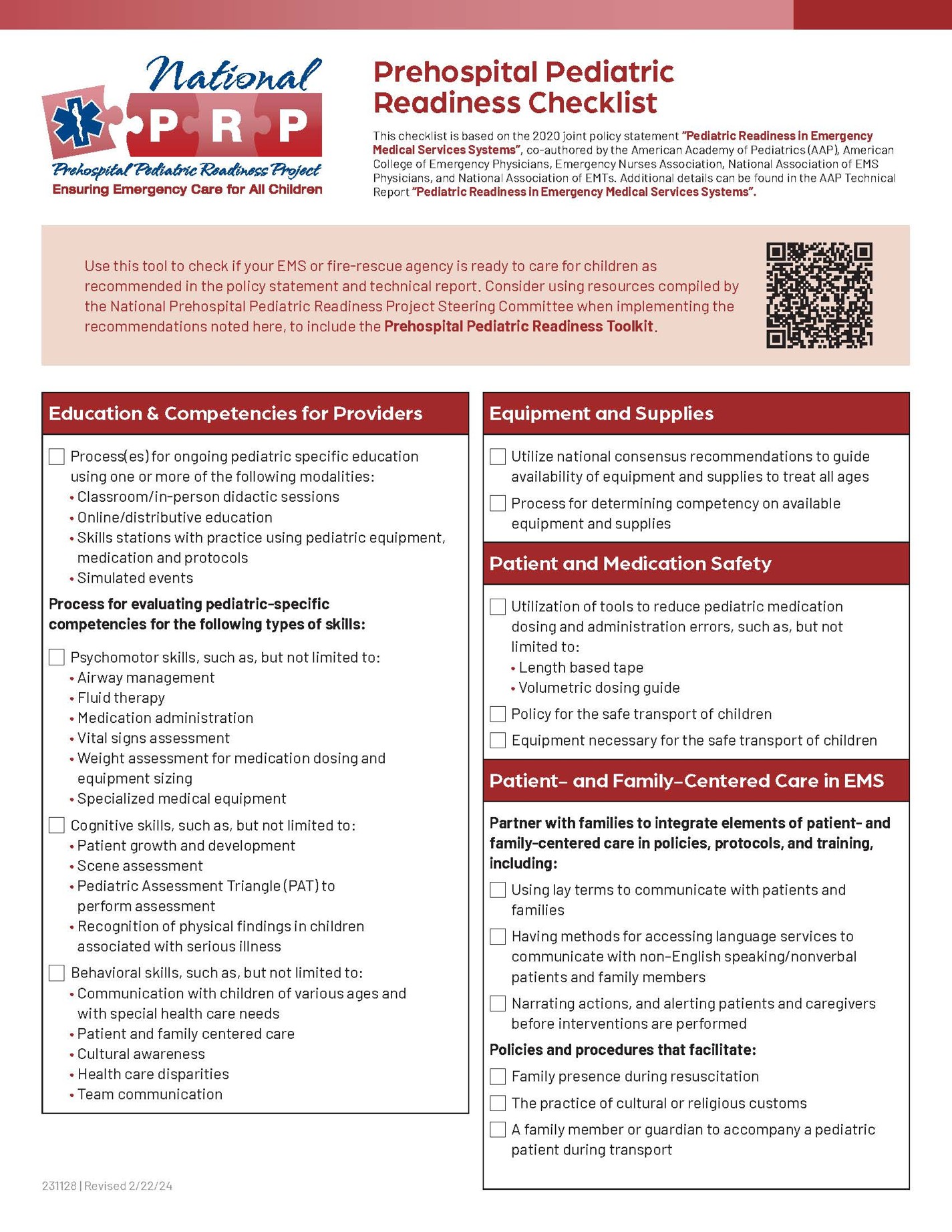
Section 3: Child Welfare & Protective Services
Identify child welfare resources and oversight bodies in the community.
| Child Protection & Support Entity | Point of Contact | Notes |
|---|---|---|
| Local/State Child Protective Services (CPS) Agency | ||
| Tribal CPS or ICWA Support Services | ||
| Juvenile/Family Court | ||
| Child Advocacy Centers |
- How is cross-jurisdictional custody handled?
- Are systems in place to determine legal custody quickly?
- Integrated into reunification planning?
Section 4: Tribal Community Considerations for Children
Use this section if your community includes tribal partners or jurisdictions.
| Topic | Prompt / Details | Notes / Response |
|---|---|---|
| Child-Focused Champion | Does the tribe(s) have a Child-Focused Champion?
|
|
| Existing Reunification Plan | Does the tribe(s) have an existing Reunification Plan? | |
| Legal Custody | Who determines legal custody of a child?
|
|
| School Infrastructure | What is the school infrastructure for the tribe(s)?
|
|
| Emergency Services Infrastructure | What is the emergency services infrastructure? Who provides…
|
|
| Public Health / Medical Services Infrastructure | What is the public health / medical services infrastructure?
|
|
| Post-Mortem Services | Who provides post-mortem services? | |
| Tribal Membership Office | Is there a tribal membership office which identifies registered members of the tribe(s)? | |
| Tribal Public Health Administrator | Is there an appointed tribal public health administrator(s)? | |
| Social Services | Are social services available?
|
|
| FEMA Tribal Liaison | Who is the tribal liaison for your FEMA region? (May be multiple)
|
Section 5: Children with Special Population Needs
Document the available resources and their capabilities for special populations.
| Capability | Present in Community? (Y/N) | Agency | Capabilities | Notes |
|---|---|---|---|---|
| Transportation operations for children with mobility needs | ||||
| Assistive technology and support services | ||||
| Caregiver training on children with disability needs | ||||
| Child psychologist or counselors | ||||
| Mobile crisis response with expertise regarding children | ||||
| Coping/grief resources for children | ||||
| Partnerships with trauma-informed care providers |
Section 6: Community Engagement for Children during Reunification Summary
Summarize the overall readiness and gaps in community resources for children for reunification planning.
| Consideration | Summary Notes |
|---|---|
| Strengths in current child-focused partnerships | |
| Identified gaps in capabilities for children | |
| Additional partners needed for future engagement | |
| Community readiness to support child reunification |
A downloadable version of this appendix is available here.
12.5. Appendix E: Reunification Tips for Families
The following tips can be shared with families to help them prepare and reduce separation time during emergencies:
- Make a Backpack Emergency Card
- Place a card in your child’s school bag with their name, parent/guardian contact information, an out-of-state contact, and any medical needs.
- CDC Backpack Emergency Card Template
- Talk With Your Child’s School About Reunification
- Ask about the school or childcare center’s reunification plan.
- If one does not exist, request that the district create one.
- Plan for Children with Special Health Care Needs
- Ensure they carry medical identification and written instructions (allergies, medications, or health conditions).
- Consider preparing a small “go-kit” with essential supplies in case separation lasts longer than expected.
- Teach Children Identifiable Information
- As soon as they are old enough, teach your child their first and last name, parents’ names, phone numbers, and the name/number of an out-of-state contact.
- Create a Family Password
- Choose a unique word or phrase only your family knows.
- Teach children to only go with adults who can provide this password.
- Establish Safe Places to Meet
- Select a family meeting place other than your home, such as a trusted neighbor’s house or a familiar landmark.
- At large public events, identify a visible meeting spot as soon as you arrive and write your phone number on a bracelet, lanyard, or tag.
- Practice Conversations with Your Children
- Rehearse what they should do if separated (for example: “find someone in charge, share your name, stay put until we find you”).
- Keep conversations calm and age-appropriate so children feel prepared rather than fearful.
- Plan for Communication During Disasters
- Use text messaging when phone calls may not go through.
- Designate an out-of-state contact who can serve as a family check-in point.
- Follow only trusted sources (law enforcement, school district, Red Cross) for reunification updates.
- Keep Updated Photos and Identification
- Carry a recent photo of your child on your phone and in your wallet.
- Save digital copies of IDs (licenses, passports, medical cards) in a secure location and keep hard copies outside your home.
- Know What to Do if a Child is Lost
- Contact local law enforcement immediately and provide detailed information about your child (age, height, eye/hair color, clothing).
- If a Family Reunification Center is opened:
- Families will be notified through official channels such as city alerts, social media, local news, or 211/311 hotlines.
- Parents/guardians should bring identification, and any documentation needed for verification, including:
- Driver’s License or government ID
- Birth certificate (if available)
- Documentation of guardianship, if applicable
- Any relevant medical information
A downloadable version of this appendix is available here.
12.6. Appendix F: Integrating Unaccompanied Minor Scenarios in Reunification Training and Exercises
Incorporating unaccompanied minors into emergency preparedness exercises enhances realism, improves response planning, and builds systemwide readiness for one of the most complex challenges in disaster response, family reunification.
The American Academy of Pediatrics (AAP) outlines ethical, developmental, and safety considerations in its guidance: Participation of Children and Adolescents in Live Crisis Drills and Exercises. This resource is essential when designing exercises that involve live child actors. It emphasizes that minors can participate in drills safely and meaningfully when guided by appropriate planning, supervision, and developmental considerations.
Recruitment of Youth Participants
When designing exercises that include child actors or observers, consider partnerships with local youth-serving organizations. Participants may earn badges, receive community service credit, or gain exposure to emergency preparedness careers.
Sources for potential child and teen participants include:
- Boy and Girl Scouts of America
- Teen Community Emergency Response Teams (Teen CERT)
- Civil Air Patrol Cadet Programs
- Junior Reserve Officers’ Training Corps (JROTC)
- Local high schools or technical schools
- Youth theater and acting groups
- School clubs
- Hospital-affiliated teen volunteer programs
- Faith-based youth groups or community centers
- Youth advisory councils or teen boards
Community-Based Reunification Scenarios
Building Explosion
Scenario:
A gas explosion impacts a mixed-use building with a licensed daycare center. Infants and toddlers are evacuated by emergency responders while adult staff and caregivers are injured or separated. The majority of children are transported to a Family Assistance Center (FAC) after being medically cleared. Many children are nonverbal or pre-verbal and unable to self-identify. Some children were too young to communicate verbally or identify their caregiver. Records from the daycare were left behind or were incomplete. Multiple caregivers arrive at the FAC, but some children remain unidentified, and staff cannot verify custody.
Key Considerations:
- Unaccompanied minor protocols specific to infants and nonverbal children
- Custody verification workflows
- Staffing roles for infants
Public Gathering Incident
Scenario:
A vehicle crashes through a barricade during a city parade, causing mass panic and injuries. Children participating in bands and performance groups scatter. Some report to businesses or aid stations; others are transported to hospitals. Many caregivers are treated on scene or hospitalized elsewhere. Social media misinformation adds to the confusion as minors surface at multiple locations across the city.
Key Considerations:
- Identification and intake of unaccompanied minors
- Implementation of child tracking
- Custody verification
School System Disruption
Scenario:
Multiple school districts are evacuated due to a wave of coordinated threats. Students are transported to off-site reunification centers managed by the different school districts. The city emergency operations center (EOC) is activated to help support safe evacuation operations. Law enforcement and transportation agencies coordinate to support safe evacuation routes, staffing at reunification sites, and communication with families. Due to custody complexities, misinformation, and caregiver delays, some children remain unclaimed.
Key Considerations:
- Coordination between city EOC, school districts, law enforcement, and transportation providers
- Testing caregiver notification systems and backup communication channels
- Verification of student release and reunification procedures
- Custody conflict resolution and legal liaison processes
- Real-time messaging through public information officers (PIOs)
Complex Coordinated Terrorist Attack (CCTA)
Scenario:
A coordinated attack affects multiple city sites, overwhelming emergency services and hospital EDs. Unaccompanied minors are transported without identification or arrive independently at hospitals, shelters, and Family Assistance Centers (FACs). Caregivers may be hospitalized, deceased, or unaccounted for.
Key Considerations:
- Triggers for reunification activation and Pediatric SME integration in ICS
- Guardian registration and custody verification
- Staff vetting, ratios, and training on child interactions and trauma-informed care
- Unaccompanied minor intake, tracking, photographic identification, and throughput processes
- Protocols for handling situations involving incapacitated, missing, or deceased guardians, including temporary custody, legal liaison processes, and communication with next of kin
- Safety, security, and access control at FACs and reunification areas
- Temporary care coordination
- Support services (medical, behavioral health, interpretation)
- Interoperable reporting and child tracking systems across hospitals, EMS, shelters, FACs, and the EOC to ensure real-time situational awareness
- Established MOUs and data sharing agreements to support coordinated response and privacy-compliant information exchange
- Joint Information System (JIS) integration to support unified public messaging, family notifications, rumor control, and media management for incidents involving children
Federal Emergency Declaration
Scenario:
Following a large-scale disaster on the coast (e.g., hurricane, earthquake, or terrorist event), a presidential emergency declaration is issued, activating federal response resources and prompting widespread evacuations from the affected region. Local capacity for medical care, sheltering, and family services is overwhelmed. Thousands of children are separated from their caregivers due to injury, illness, transportation disruptions, or confusion during evacuations and sheltering operations.
In response, the Emergency Management Assistance Compact (EMAC) is activated to mobilize inter-state support. The National Disaster Medical System (NDMS) deploys resources to transport and care for patients, including children, across multiple states. Your city is identified as a reception hub, tasked with receiving evacuees, including unaccompanied minors.
Some children arrive without clear documentation or adult supervision. Others are separated during triage or NDMS transport and are admitted to NDMS- designated hospitals without confirmed identification. Families are scattered across jurisdictions, creating complex reunification challenges.
Key Considerations:
- Reception site planning and staffing for children
- Tracking and documentation of unaccompanied minors
- Legal authority and custodial decision-making for children arriving without guardians
- Age-appropriate, trauma-informed communication and language access
- Protection measures against abuse, neglect, or exploitation at reception sites
- NDMS coordination with pediatric-capable facilities
- Child-specific data sharing across health, sheltering, and family services
- EMAC integration of child welfare and pediatric response resources
- Multijurisdictional coordination among hospitals, shelters, child welfare, and emergency management
Additional reunification exercise materials can be found at:
Player Card Summary
This section provides a summary of unaccompanied minor player cards for use in a community reunification exercise. Each card provides key identifying information, communication and functional considerations, and details about the associated guardian (when applicable). These scenarios are intentionally diverse and realistic, designed to help communities assess and strengthen their ability to address the unique needs of children during a response.
| ID | Name/Disaster Name | Age | Communication/Functional Type | Associated Guardian Card | Guardian Relationship & Status |
|---|---|---|---|---|---|
| UM01 | Oregon Willow | 9 yrs | Verbal | G01 | Parent |
| UM02 | Florida Coral | 13 yrs | Verbal | G02 | Parent |
| UM03 | Nevada Rain | 8 yrs | Verbal, Sibling UM15 | G03 | Parent |
| UM04 | Montana Clover | 15 yrs | Verbal, Religious/Cultural Consideration | G04 | Parent |
| UM05 | Missouri Peach | 6 yrs | Verbal | G05 | Aunt - No Documentation Provided |
| UM06 | Nebraska Apple | 4 yrs | Verbal | G06 | Parent – No Documentation Provided |
| UM07 | Illinois Cherry | 9 yrs | Verbal | G07 | Parent – No Documentation Provided |
| UM08 | Maine Juniper | 7 yrs | Verbal | G08 | Grandparent – No Documentation Provided |
| UM09 | Texas Kiwi | 5 yrs | Verbal, Mobility Impairment | G09 | Babysitter - No Documentation Provided |
| UM10 | Arizona Pine | 7 yrs | Non-Verbal, Language Accessibility | G10 | Parent |
| UM11 | Wyoming Fern | 8 yrs | Verbal, Language Accessibility | G11 | Parent |
| UM12 | Alaska Birch | 16 yrs | Verbal, Language Accessibility, Undocumented | G12 | Family Friend – Undocumented |
| UM13 | Iowa Blackberry | 7 yrs | Non-Verbal, Developmental Delay | G13 | Foster Caregiver - Incomplete Documentation |
| UM14 | Kansas Mango | 10 yrs | Non-Verbal, Neurodivergent | G14 | Sibling - No Documentation Provided |
| UM15 | Utah Sage | 10 yrs | Verbal, Sibling UM03 | G03, G15 | Parents - Custody Concern |
| UM16 | Vermont Snowdrop | 6 mo | Non-Verbal | G16 | Parent – Delayed Arrival for Reunification |
| UM17 | Washington Agave | 10 yrs | Verbal, Emotional Distress | N/A | Guardian - Not Identified or Unreachable |
Injects
Reunification Process & Custody Conflicts
- A relative shows up to claim custody of children after learning the parent is deceased. No formal guardianship paperwork exists.
- An interstate custody order exists for a child at the FAC, but the local jurisdiction has not confirmed the order’s enforceability.
- A tribal representative arrives to claim custody of a child enrolled in a federally recognized tribe. A non-tribal foster parent also seeks reunification.
- A child is matched to a guardian who has reported deceased at the scene.
- A guardian is mistakenly told the child is deceased, but the child is later found alive in another FAC.
- A teen parent is trying to reunify with their infant but is being treated as a sibling.
Language, Culture, & Interpretation Challenges
- A child speaks an Indigenous Central American language and cannot understand the available interpreter.
- A staff member attempts to calm a child by touching their shoulder, unaware this violates the child’s cultural norms.
Mental and Behavioral Health, & Trauma Responses
- A child becomes inconsolable and starts hitting themselves.
- A teenager discloses thoughts of self-harm to a volunteer.
- A child who witnessed the disaster begins hyperventilating and screaming during intake.
- A child with autism becomes overstimulated by noise and lighting in the UMSA.
- A child with an intellectual disability does not understand the intake questions and becomes confused and withdrawn.
- A child believes law enforcement officers will deport them and flees the UMSA when they see a uniformed officer.
- A child asks why some children are being reunited and not them.
- A child asks if their parents are dead because no one will give them updates.
- A teen asks what will happen if their parents are undocumented and can’t come to pick them up.
- A child who identifies as LGBTQ+ requests a safe adult to speak to, citing fear of discrimination by a guardian.
Medical Needs & Accessibility Gaps
- A child with a known peanut allergy is given donated snacks containing trace peanuts.
- A child with an insulin pump shows signs of hypoglycemia, but medical response is delayed.
- A child’s wheelchair was left behind during evacuation. They are now without mobility support.
- A child with oxygen support has a low tank and no backup available.
- A child develops a rash and fever; others in the UMSA were in close contact.
- A child showing signs of dehydration and illness, but no pediatric provider is currently available at the FAC.
- A child requires daily medication, but the supply was left behind.
- A child with a visual impairment has lost their assistive device and is struggling to navigate the FAC.
Security & Identification Concerns
- An adult presents a birth certificate to claim a child, but the name does not match photo ID.
- A local reporter gains unauthorized access to a photo of unaccompanied children in the UMSA and publishes it.
Social Media & Public Misinformation
- A new volunteer is posting selfies inside the UMSA, with children visible in the background.
- A teen in the UMSA posts that “kids are being taken by CPS” and tags local media. The post goes viral.
- A child posts a TikTok from inside the UMSA and jokes, “they’ve locked us up.”
Inbound Inquiries & Communication
- FAC phone lines are being overwhelmed with family members trying to locate children.
- A parent in the FAC is awaiting reunification when a hospital reports their child is deceased.
- A child’s only confirmed guardian is in critical care, unable to consent to reunification.
Unaccompanied Minor Safe Area (UMSA) Conditions
- A child has been in the UMSA for over 24 hours. No family has been identified.
- The UMSA is out of diapers and wipes.
- Children have not had access to showers or clean clothing in over 48 hours. Odors are impacting behavior and wellbeing.
- Hunger is escalating behavioral issues in the children.
- A volunteer took an infant to a quieter space without informing anyone. Staff notice the infant missing.
Abuse, Neglect, & Trafficking Risks
- A youth arrives with a man who insists on interpreting.
- A 13-year-old girl arrives with an adult claiming to be her cousin. The child seems fearful and gives inconsistent answers.
- A child refuses to go with an adult claiming to be their parent, whispering to a staff member, “Please don’t let them take me.”
- A child presents with healing bruises and flinches when touched. The accompanying guardian is hostile and intimidating.
Marginalized & Vulnerable Populations
- A child enrolled in a federally recognized tribe is subject to ICWA, but a tribal rep has not arrived.
- A child with DACA status is hesitant to provide personal information due to deportation fears.
- A mother discloses she is undocumented and is afraid to submit any identifying information.
Printing Instructions for Player Cards and Injects
The following pages contain formatted player cards for use in community reunification exercises. Each page displays one unaccompanied minor card alongside their associated guardian card(s), when applicable, on a single side of the page.
General Guidelines
- Paper Size: Standard 8.5” x 11” (letter size)
- Orientation: Landscape
- Print Format: Single-sided only — each unaccompanied minor and their associated guardian(s) appear together on the same page
- Print Settings: Use “Fit to Page” or “Shrink to Fit” to ensure complete visibility of all card details
- Print Quality: Designed for both color and black & white; color printing may improve readability
- Durability: For repeated use, print on cardstock and/or laminate the pages
Back-to-Back (Double-Sided) Printing
Cards are formatted for double-sided (duplex) printing to conserve paper and streamline handling:
- Layout: Each unaccompanied minor card is followed by the corresponding guardian card(s), when applicable.
- Printer Setting: Choose “Print on both sides” and select “Flip on short edge” when printing in landscape orientation.
- Alternative Option: If double-sided printing is unavailable, cards may be printed single-sided and clipped or assembled manually.
Ensure the print order and orientation are correct by testing a sample before printing in bulk.
A downloadable version of this appendix, including the flashcards, is available here.
12.7. Appendix G: FRC ICS Organizational Chart
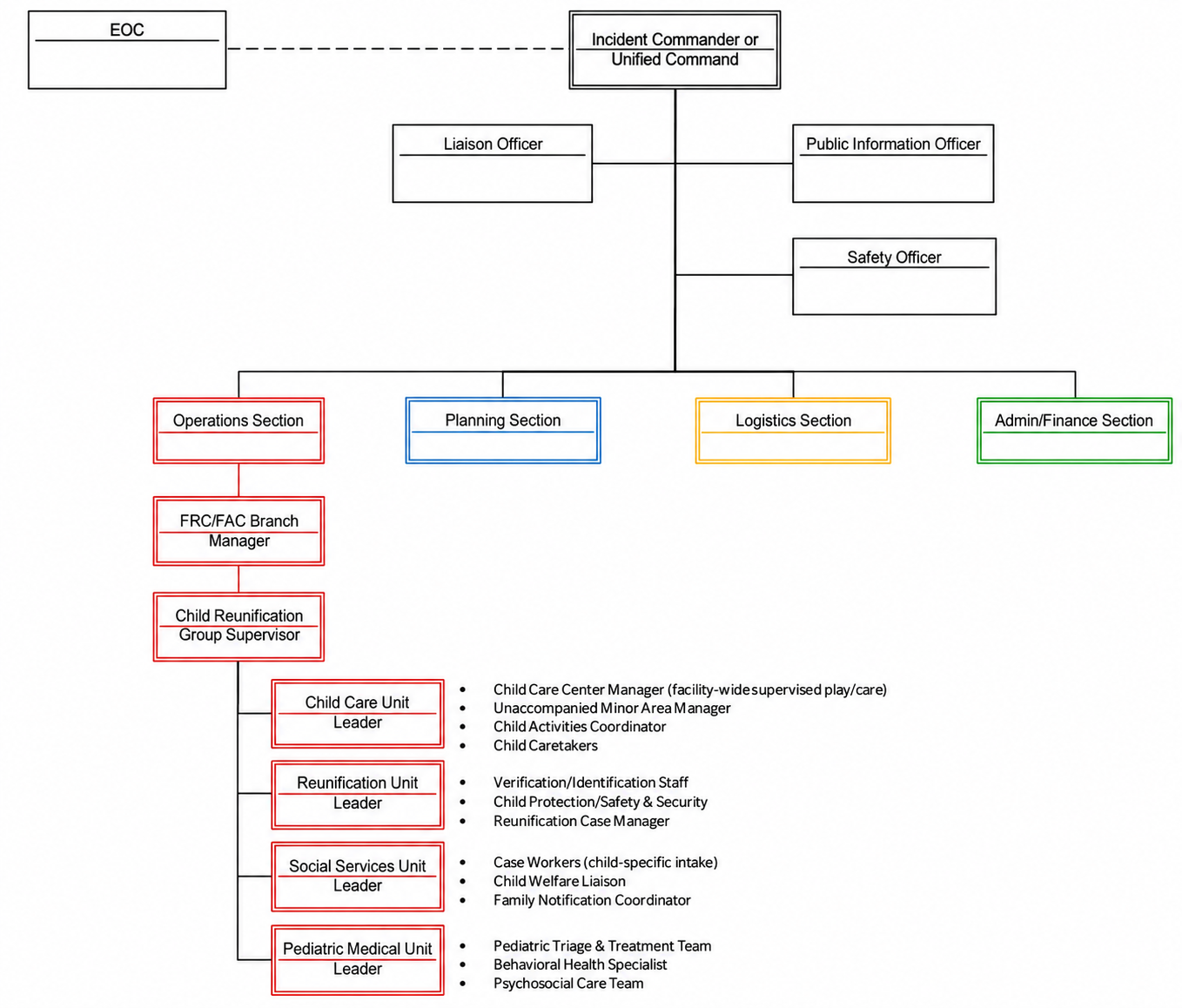
A downloadable version of this appendix is available here.
12.8. Appendix H: FRC ICS Child Reunification Group Supervisor Job Action Sheet
Provides guidance for the Child Reunification Group Supervisor in coordinating child-focused reunification activities.
FRC/FAC Position Assignment
| Position Reports to: FRC/FAC Branch Manager | FRC/FAC Location: | |
| FRC/FAC Phone: | ||
| Position Assigned to: | Start: ____:____ hrs. End: ____:____ hrs. |
|
| Signature: | Date: ____ / ____ / ____ | |
| Immediate | Time |
|---|---|
Assess the operational situation
|
|
Activities
|
|
Documentation
|
|
Communication
|
| Initial Operations | Time |
|---|---|
Activities
|
|
Documentation
|
|
Communication
|
| Ongoing | Time |
|---|---|
Activities
|
|
Documentation
|
|
Communication
|
| Demobilization | Time |
|---|---|
Activities
|
|
Documentation
|
A downloadable version of this appendix is available here.
12.9. Appendix I: FRC Child-Focused Staff Job Action Sheet
Guides child-focused staff in supporting the safe and efficient reunification of children with their guardians within the FRC.
| Position Reports to: Child Reunification Group Supervisor and/or Unit Leader | Command Center Location: | |
| Command Center Phone: | ||
| Position Assigned to: | Start: ____:____ hrs. End: ____:____ hrs. |
|
| Signature: | Date: ____ / ____ / ____ | |
| Immediate | Time |
|---|---|
Receive Appointment
|
|
Activities
|
|
Documentation
|
|
Communication
|
| Initial Operations | Time |
|---|---|
Activities
|
|
Documentation
|
|
Communication
|
| Ongoing | Time |
|---|---|
Activities
|
|
Documentation
|
|
Communication
|
| Demobilization | Time |
|---|---|
Activities
|
|
Documentation
|
A downloadable version of this appendix is available here.
12.10. Appendix J: Recommended Staff: Child Ratio and Group Size: Child Care Center
Staff: child ratio and group size requirements vary by state and type of program. Check your state’s or territory’s staff: child ratio and group size requirements for licensed childcare programs by selecting your state or territory and reviewing the “Understanding and Finding Child Care Resources” page.
The chart below provides some general recommendations from early childhood experts for safe staff: child ratios and group sizes.
| Ages | Staff: Child Ratio | Group Size |
|---|---|---|
| Infants: Younger than 12 months old | 1 adult should care for no more than 3 infants | No more than 6 infants in a group or class |
| Toddlers: 13–35 months old | 1 adult should care for no more than 4 toddlers | No more than 8 toddlers in a group or class |
| Preschoolers: 3 years old | 1 adult should care for no more than 7 preschoolers | No more than 14 preschoolers in a group or class |
| Preschoolers: 4 years old | 1 adult should care for no more than 8 preschoolers | No more than 16 preschoolers in a group or class |
| Preschoolers: 5 years old | 1 adult should care for no more than 8 preschoolers | No more than 16 preschoolers in a group or class |
| School-age children: 6–8 years old | 1 adult should care for no more than 10 school-age children | No more than 20 school-age children in a group or class |
| School-age children: 9–12 years old | 1 adult should care for no more than 12 school-age children | No more than 25 school-age children in a group or class |
ChildCare.gov provides recommendations for best practices and how to ensure health and safety in child care spaces - https://childcare.gov/consumer-education/regulated-child-care
American Academy of Pediatrics, American Public Health Association, & National Resource Center for Health and Safety in Child Care and Early Education. (2019).
A downloadable version of this appendix is available here.
12.11. Appendix K: Guardian Registration Form
To collect essential information from guardians to support family reunification efforts during a response.
| Parent or Legal Guardian Information | |||
| Primary Parent/Guardian Name: | |||
| Primary Contact Number: | Type: ☐ Mobile ☐ Home ☐ Work | ||
| Secondary Parent/Guardian Name: | |||
| Secondary Contact Number: | Type: ☐ Mobile ☐ Home ☐ Work | ||
| Child Information | |||
| Child’s Name (Last, First, Middle): | DOB: ____________________ ☐ Unknown | ||
| Primary Address: | Age: __________ Mo / Yrs. (circle one) | ||
| Primary Language: ☐ English ☐ Spanish ☐ Other _____________________ ☐ Non-verbal | |||
| Gender ☐ Female ☐ Male ☐ Other | |||
| Eye Color ☐ Brown ☐ Blue ☐ Green ☐ Gray ☐ Multiple ☐ Other _____________________ | |||
| Hair Color ☐ Brown ☐ Blonde ☐ Black ☐ Red ☐ Other _____________________ | |||
| Identifying Features: ☐ Scars ☐ Moles ☐ Birthmarks ☐ Tattoos ☐ Braces ☐ Missing Teeth ☐ Glasses ☐ Other: |
Items worn by or with child: ☐ Pants/Shorts ☐ Shirt ☐ Dress/Skirt ☐ Shoes/Socks ☐ Coat/Jacket ☐ Jewelry ☐ Medical Devices ☐ Other: |
||
| Identifying Features Description: | Items Worn by or with Child Description: | ||
| Siblings: ☐ None ☐ 1 ☐ 2 ☐ 3 ☐ 4+ ☐ Unknown | Sibling’s Name(s): | ||
| School Grade: ☐ N/A ☐ Pre-K ☐ Kindergarten ☐ 1st ☐ 2nd ☐ 3rd ☐ 4th ☐ 5th ☐ 6th ☐ 7th ☐ 8th ☐ 9th ☐ 10th ☐ 11th ☐ 12th ☐ Unknown |
|||
| School Name: | Teacher’s Name: | ||
| Pet(s): ☐ None ☐ Dog ☐ Cat ☐ Other ___________ ☐ Unknown |
Pet Names: | ||
Completed by FRC Staff
| Review Status |
| Status: ☐ Parent/Guardian Submission Staff Reviewer: ___________________________ Time: ________________ ☐ In Review Staff Reviewer: ___________________________ Time: ________________ ☐ Complete Staff Reviewer: ___________________________ Time: ________________ |
| Additional Details: |
A downloadable version of this appendix is available here.
12.12. Appendix L: Child Intake Form
To collect identifying information for unaccompanied minors during registration at the Family Reunification Center.
| Child Information | |||||||
| Name (Last, First, Middle): | DOB/Age: _____________ ☐ Unknown | ||||||
| Eye Color: ☐ Brown ☐ Blue ☐ Green ☐ Hazel ☐ Other |
Hair Color: ☐ Brown ☐ Blonde ☐ Black ☐ Red ☐ Other |
||||||
| Primary Language: ☐ English ☐ Spanish ☐ Other: ________________________ ☐ Non-verbal | |||||||
| Identifying Features: ☐ Scars ☐ Moles ☐ Birthmarks ☐ Tattoos ☐ Braces ☐ Missing Teeth ☐ Glasses ☐ Other: |
Items worn by or with child when found: ☐ Pants/Shorts ☐ Shirt ☐ Dress/Skirt ☐ Shoes/Socks ☐ Coat/Jacket ☐ Jewelry ☐ Medical Devices ☐ Other: |
Photo Attach a photo here |
|||||
| Describe all checked items: | |||||||
| Describe where the child was found (Be as specific as possible, including neighborhood/street names): | |||||||
| Arrival to Family Reunification Center | |||||||
| Method: ☐ Private Vehicle ☐ EMS ☐ Public Transport ☐ Other: | |||||||
| Details of Arrival: | |||||||
| Wristband Placed on Child: ☐ Yes ☐ No |
Staff Responsible for Registration (Print Name): | ||||||
| Additional Information | |||||||
| Parent/Guardian Name: | Parent/Guardian Contact Number: | ||||||
| Parent/Guardian Location Known? ☐ Yes ☐ No Current Location: |
Additional Family Member Names, Age, Location, & Contact Number? ☐ Sibling(s) ☐ Grandparent ☐ Aunt/Uncle ☐ Cousin ☐ Other____ |
||||||
| Pet Name(s): ☐ Dog ☐ Cat ☐ Other___________ |
|||||||
| Name of School: | Grade: | Teacher(s) Name: | |||||
| Disposition | |||||||
| ☐ Child Transferred to another facility/agency (Facility Name): Address: ______________________________________________ Phone: ______________________ Contact: ______________________________________________ Transport Agency: ______________________ |
|||||||
| Parent/Guardian Contacted? ☐ Yes ☐ No Contacted By: Date/Time: |
|||||||
| ☐ Child Released to (Full Name): ______________________________________________ Known to Child? ☐ Yes ☐ No Relationship to Patient: ☐ Parent/Guardian ☐ Sibling ☐ Aunt/Uncle/Cousin ☐ Grandparent ☐ Other: __________ Picture Identification: ☐ Driver’s License ☐ Passport ☐ Work/School ID ☐ Other: ______________________ Address on ID: ______________________________________________ Consent obtained from parent/guardian if released to another adult? ☐ Yes ☐ No (explain): |
|||||||
| ☐ Signature of Individual Assuming Responsibility for Child (Sign, Date, Time): | |||||||
A downloadable version of this appendix is available here.
12.13. Appendix M: Reunification Pathway
This flowchart provides an example of the operational pathway for reunification efforts involving unaccompanied minors.
A downloadable version of this appendix is available here.
12.14. Appendix N: FRC Safety & Security Checklist for Children
This checklist ensures that all areas where children may be present are operated with both physical and emotional safety in mind.
| Section 1: Community Education Partners |
| ☐ Single controlled point of entry and exit, monitored by FRC staff or security ☐ Clearly designated zones for different age groups:
☐ Sufficient space for supervised play, minimizing risk of injury from running or overcrowding ☐ Age-appropriate toys free of choking hazards and regularly sanitized ☐ Covered electrical outlets and secured cords ☐ Furniture free of sharp corners; corners padded where needed ☐ Hot water temperature regulated to prevent scalding ☐ Running hot and cold water available ☐ Diaper-changing area with privacy and sanitation supplies ☐ Clean, accessible bathrooms suitable for various age groups ☐ Trash storage with child-safe, lidded receptacles ☐ Overflow space identified and ready for surge operations |
| Section 2: Intake and Registration Area |
| ☐ Controlled entry with security or greeter presence ☐ Age-appropriate seating and distractions available (e.g., books, toys) ☐ Visual privacy and quiet space for children with sensory needs ☐ Child-friendly signage and visual aids for non-verbal or developmentally delayed children ☐ Language access and interpreter services available ☐ Wristbands or ID tags linked to intake documentation ☐ Protocols in place to identify unaccompanied minors and trigger safeguarding process |
| Section 3: Waiting Areas (General or Family) |
| ☐ Supervision zones clearly defined and monitored ☐ Soft seating or floor space for children to rest or play ☐ Safe distance from exits or hazardous areas (e.g., kitchens, storage) ☐ Behavioral health staff or child life specialists accessible for children in distress ☐ Access to basic supplies (blankets, snacks, water, comfort items) |
| Section 4: Pediatric Medical & Isolation Zones |
| ☐ Child-sized equipment and seating ☐ Privacy screens and visual barriers where appropriate ☐ Appropriately trained pediatric staff and volunteers ☐ Basic pediatric first aid kit and PPE available ☐ Clean surfaces and protocols for toy/equipment disinfection ☐ Protocols for managing infectious symptoms while minimizing trauma |
| Section 5: Behavioral Health and Psychosocial Support Area |
| ☐ Quiet, calm space away from high-traffic areas ☐ Staff trained in trauma-informed approaches with children ☐ Visual aids, fidget items, and calming activities available ☐ Privacy for one-on-one support or group coping sessions ☐ Clear, developmentally appropriate communication tools for children in crisis |
| Section 6: Feeding/Nutrition Area |
| ☐ Designated spaces for feeding children of all ages. ☐ Access to refrigeration and handwashing stations that are child appropriate. ☐ Safe storage for all food including formula, baby food, and allergen-free options ☐ Seating appropriate for children and caregivers ☐ Adult supervision during all meal and snack times |
| Section 7: Restrooms and Hygiene Stations |
| ☐ Located near areas with children and have visible signage ☐ Accessible to children of all ages, with child-sized features when possible ☐ Changing tables with sanitizing supplies and waste disposal ☐ PPE and hand hygiene stations adjacent to restroom entry/exit |
| Section 8: Transition and Release |
| ☐ Secured child release area with custody verification protocols ☐ Visual and verbal ID matching between child and caregiver ☐ Trained staff or caseworkers to support reunification discussions ☐ Privacy and emotional support available for high-stress releases ☐ Documentation maintained for all child releases or transitions |
A downloadable version of this appendix is available here.
12.15. Appendix O: Call Center Script
12.15. Appendix O: Call Center Script
This sample script provides guidance for FRC call line staff assisting parents, caregivers, or guardians in reporting or locating missing children during reunification operations.
Agent:
“Thank you for calling the [Agency/Organization Name] Family Reunification Call Line.
My name is [Agent Name], and I’m here to assist you.
Is this call regarding a missing or separated child due to the recent [emergency/disaster name]?”
(Wait for confirmation.)
Agent:
“First, I need to collect some information to assist with your report.
May I have your full name and your relationship to the missing child?”
Information to Collect from the Caller:
- Full name
- Relationship to the child
- Primary phone number
- Is this number for a mobile phone, home, or workplace?
- Alternate contact number (if available)
- Is this number for a mobile phone, home, or workplace?
- Preferred language (if applicable)
- Primary address
Agent:
“Thank you. I’ll now ask for some details about the child who is missing or separated.
It’s okay if you don’t know the answer to every question.”
Information to Collect About the Child: (Replace “your child” with the child’s name for reference once known.)
(Information collected about the child should align with the organization's Child Intake Form to ensure accuracy and coordination across systems.)
- What is your child’s full name?
- Does your child have any nicknames? If yes, then what are they?
- How old is your child?
- What is your child’s date of birth?
- What gender is your child?
- What is your child’s hair color?
- What is your child’s eye color?
- Does your child have any distinguishing features such as birthmarks, scars, glasses, braces? Please describe.
- What clothing was your child last seen wearing?
- Do you know your child’s last known location (address, intersection, or known landmark)?
- Was the child with anyone during the event? If yes, then ask the following:
- Who was the child with?
- Relationship to the child?
- What does the child call this person?
- How many siblings does your child have?
- What are their names?
- What does your child call them?
- How old are they?
- Does your child attend school? If yes, then ask the following:
- What grade is your child in?
- What school does your child go to?
- What is your child’s teacher’s name?
- Do you have pets? If yes, then ask the following:
- What kind of pets do you have?
- What are your pets’ names?
- What does your child call the pet(s)?
- Does your child have a favorite toy or comfort item? If yes, ask the following:
- What is the toy/comfort item?
- Does your child call this toy/comfort item by a specific name? (e.g., “blankie”, “Robbie the Rabbit”)
- Are there other family members or trusted adults the child regularly stays with? If yes, then ask the following:
- What is their relationship to the child?
- What is their name?
- What does your child call them?
- Is there anything else about your child that you would like to share with us?
Agent:
“I’m going to enter this information into our system to create a report. This may take a moment.”
(Agent creates or updates the case record and assigns a case number.)
Agent:
“The report has been submitted. Your case number is [Case Number].
Please keep this number for reference in case you need to call again or share updates.”
Agent:
“We are coordinating with local emergency services, shelters, hospitals, and child welfare partners through the Family Reunification Center network. If the child is located, you will be contacted immediately. In the meantime, here are some steps you can take while we continue the search:”
- Stay informed: Monitor local news, social media, and official updates about the disaster and any information regarding missing persons.
- Reach out to others: Contact family members, caregivers, or friends who may have seen or heard from the child.
- Stay organized: Keep a record of all the agencies and shelters you have contacted, along with any updates received.
- Keep identification and legal documents accessible: You may need to provide identification, custody, or adoption paperwork during the reunification process.
- Have a recent photo ready: Keep a clear, recent image of the child available for verification if requested.
- Be patient and persistent: While we are working as quickly as we can, this process can take some time. We will update you as soon as possible.
- Take care of yourself: Ensure that you are taking care of your own physical and emotional needs.
Agent:
“If you receive any updates or new information about the child’s location or well-being, please contact the Family Reunification Call Line right away.”
Agent: (Optional, if resources are available)
“This is a difficult and overwhelming situation. You are not alone, and we are doing everything we can to support families during this time. Would you like me to connect you with a support counselor or mental health resource?”
(If the caller would like additional support)
Agent: “Thank you again for calling and providing this important information. We will contact you as soon as we have any information. Please reach out with any updates or questions at any time. I will transfer you to additional support resources now, but if we get disconnected, the phone number is [XXX]-XXX-XXXX.”
(If the caller does not want additional support services or those resources are not available)
Agent:
“Thank you again for calling and providing this important information. We will contact you as soon as we have any information. Please reach out with any updates or questions at any time. Take care and stay safe.”
A downloadable version of this appendix is available here.
12.16. Appendix P: Public Messaging Script Regarding Unaccompanied Minors
This section provides sample messaging to communicate with the public after an emergency or disaster. Messages can be adapted for press releases, social media, websites, or announcements to help families report or locate separated children.
Public Alert Template
PUBLIC ALERT: Family Reunification After [Disaster Name]
[Date] - [Time]
[City/County/State] – Following the recent [Disaster Name] event, authorities are working diligently to reunite families and individuals who may have been separated. If you are looking for a missing loved one, or if you have information about someone who may be separated from their family, please do one of the following:
- Call our hotline: You can reach out to our team by phone at [INSERT HOTLINE PHONE NUMBER HERE].
- Complete an online inquiry form: You can complete an inquiry form online at our website: [INSERT WEBSITE HERE].
- Make an in-person inquiry: You can come to the Family Assistance Center located at [INSERT ADDRESS HERE].
- Found children: Anyone who finds a child separated from their parents or legal caregivers should contact any available first responder or our hotline at [INSERT HOTLINE PHONE NUMBER HERE] for further instructions.
- Let family members know you are safe: Use the American Red Cross Safe and Well program to let family members know you are safe or to search for loved ones.
Public Messaging Tips
- Post accurate, centralized updates about reunification services across official platforms (websites, social media, SMS).
- Use consistent hashtags or page links to reduce confusion and misinformation.
- Flag or report false reunification reports or impersonation attempts.
- Avoid posting identifiable information or images of children unless:
- The child is still missing, and permission has been granted by legal guardians or authorities, or
- It is essential for recovery and vetted by law enforcement
A downloadable version of this appendix is available here.
12.17. Appendix Q: FRC Child-Focused Resources for Staff
This section provides staff with child-focused tools and resources to support reunification operations.
Talking with and Supporting Children After a Crisis
(Adapted from the American Academy of Pediatrics – HealthyChildren.org: “Talking to Children About Tragedies and Other News Events”)
Core Principles
- Use calm, simple, reassuring language.
- Be honest but avoid unnecessary or graphic details.
- Give age-appropriate explanations and reassurance that they are safe.
- Let children ask questions and express feelings freely.
- Keep siblings together when possible.
- Model calm behavior. Children mirror adult tone and body language.
Where to Start
- Ask what they’ve heard. Most children already know something.
- Ask what questions they have. Listen first, then clarify.
- Correct misinformation gently and simply.
- Reassure: “You are safe here. We’re helping families find each other.”
Talking Points
- “It’s okay to feel sad, scared, or angry. Lost of people feel that way after something scary happens.”
- “Adults are working hard to help your family and keep you safe.”
- “If you have questions or worries, you can talk to me or another helper here.”
Young Children (Preschool–Elementary)
- Keep it short and simple (“There was a big storm, but you’re safe here.”).
- Avoid showing or discussing graphic details or media coverage.
- Offer comfort through calm voices, routines, and quiet activities.
Older Children and Teens
- Provide a little more information if they ask for it.
- Encourage honest questions and emotional expression.
- Reinforce that the event is not their fault.
- Offer healthy outlets like drawing, writing, or helping others.
Children with Developmental Delays or Disabilities
- Match explanations to developmental level, not age.
- Use visuals or familiar routines to support understanding.
- Respect individual comfort needs or sensory sensitivities.
Watch for Signs of Distress
- Trouble sleeping or frequent nightmares
- Physical complaints (headache, stomachache, fatigue)
- Regression or clinginess
- Withdrawal, irritability, sadness
- Appetite or behavior changes

Supporting Children with Autism and Developmental Delays at the FRC
Just-in-time guidance for staff to support children with autism and other developmental delays as they may experience heightened anxiety, sensory overload, and behavioral challenges during or after a disaster.
- Immediate Actions
- Ask for Familiarity: If possible, check with known adults or older sibling about items the child prefers to hold or play with.
- Provide Comfort Items: Offer favorite toys (blocks, cars), soft blankets, or sensory items.
- Maintain Routine: Keep predictable schedules and familiar activities whenever possible.
- Use Visual Supports: Picture schedules or visual aids help communicate changes in routine or location.
- Communication Tips
- Speak Calmly and Clearly: Use simple language, short sentences, and a reassuring tone. Match the child’s communication level and height.
- Avoid Overstimulation: Reduce simultaneous talking, touching, and eye contact. Limit exposure to bright lights and loud noises.
- Be Patient: Allow extra time for processing and responding.
- Remember Developmental Level: A child’s communication or problem-solving may not match their appearance. Adapt your approach accordingly.
- Managing Tantrums or Meltdowns
- Safety First: Remove objects that could cause injury.
- Ask for Guidance: Check with familiar adults or siblings for strategies that usually help.
- Provide Brief Reassurance: Stay nearby but avoid excessive talking, touching, or showing frustration, which can escalate the situation.
- Sensory Toolkit: Recommended Items
Category and Items
- Sensory Management
- Fidget toys, stress balls, spinners, textured toys, weighted blankets or vests, noise-canceling headphones, soft lighting, oral motor tools, light-up toys
- Communication Aids
- Visual schedules, PECS (Picture Exchange Communication System) cards, social stories, communication boards
- Supportive Items
- Chargers, tablets with games and parental controls, soft dry clothing, diapers (child and adolescent sizes)
- Safety Equipment
- Soft mats/padding, door alarms/locks, safety gates, visual safety signs, first-aid kit
- Sensory Management
Tips for Use:
-
- Introduce one item at a time.
- Provide guidance and instruction.
- Supervise use, especially with small or chewable items.
- Offer choices, allow children to select items.
- Ensure all items are safe, non-toxic, and age appropriate.
- Be flexible; adjust the toolkit as the child’s needs change.
- Preparing the Family Reunification Center
Items to Prepare:
-
- Simple visual schedule for daily activities (sample)
- Social stories (sample , Resource Link 1, Resource Link 2)
- Clear signage with picture cues for instructions
Space Setup:
-
- Designate a quiet, predictable area for retreat with low lighting and soft seating.
- Minimize excess toys and materials to reduce overstimulation.
- Post clear visual cues to guide movement through the center.
- Use gates to prevent elopement.
- Have a plan for managing challenging behaviors or meltdowns.
Waiting at the Center: A Visual Schedule
This visual schedule will show you what you can do at the center while you wait for your adult.
Here are the steps:
We hope you enjoy your time at the center while you wait!

Staying at the Center Until a Known Adult Arrives
A downloadable version of this appendix is available here.
12.18. Appendix R: Guidance for Families Regarding Social Media
The following tips can help families protect children and ensure they are sharing information responsibly during reunification operations.
As reunification efforts take place after an emergency or disaster, social media can be a valuable tool, but it also presents real risks, especially for children. During this sensitive time, it is critical to prioritize safety, emotional well-being, and the protection of personal information.
- Be Alert for Misinformation
- Rely only on official sources (e.g., government agencies, NCMEC, Red Cross, verified emergency accounts) for updates about reunification centers, shelters, and rescue efforts.
- Do not share or repost unverified information, including names, photos, or rumors about missing children or survivors.
- Help children and teens understand that not everything they read or see online is true, even when it appears urgent or emotional.
- Guard Personal Information
- Do not post or share the real-time locations of children, families, or reunification centers unless directed by official authorities.
- Avoid sharing:
- Full names of children
- Dates of birth
- School Names
- Shelter or hotel locations
- Contact numbers
- Other identifying details or images
- When communicating about sensitive matters, use private and secure channels such as encrypted messaging apps.
- Prevent Exploitation or Predatory Contact
- Be cautious of individuals online who offer help, transportation, or accommodation.
- Do not respond to messages from unknown people, even if they claim to be rescuers or “friends”.
- If suspicious contact or requests for personal information occur, report them immediately to authorities or platform moderators.
- Limit posting or sharing reunification photos unless consent is clearly given by all parties involved.
- Protecting Children’s Emotional Well-Being
Limit Exposure to Disturbing Content
-
- Do not allow children to scroll unsupervised through platforms like TikTok, Instagram, Facebook, or X (Twitter), where graphic images and traumatic stories may appear.
- Adults should preview content before sharing updates with children.
- Turn off autoplay and disable notifications on apps that may repeatedly show distressing content.
- Encourage offline activities to reduce stress and provide stability.
Support Emotional Regulation
-
- Avoid long periods of social media scrolling, which can overwhelm children emotionally.
- Reassure children with clear, calm updates in plain language.
- If a child becomes anxious after using social media, help them identify what upset them and guide them back to safe, regulated content or away from screens entirely.
- Connect children with trained counselors or crisis support if they’re showing signs of distress, withdrawal, or fear related to online content.
Watch for Cyberbullying or Harassment
-
- Children may be targeted online by peers or strangers during vulnerable moments.
- Monitor accounts for signs of bullying, such as:
- Name-calling or threats
- Reposts of distressing content
- Insensitive comments on public updates
- Encourage children to speak up if they feel unsafe or attacked online. Block and report any abusive users.
A downloadable version of this appendix is available here.
12.19. Appendix S: UMSA (Unaccompanied Minor Safe Areas) Location Assessment Tool
This checklist is designed to identify strengths and gaps before activation, ensuring the site can safely support children during reunification operations.
Instructions: For each item select the rating that best reflects the site:
- High (Good): Fully meets safety and suitability requirements.
- Moderate (Some Concerns): Minor issues present, manageable with adjustments.
- Low (Not Suitable): Significant issues, not appropriate without major modifications
Area Reviewed: ___________________________ Date Reviewed: ___________________________ Reviewer: ___________________________
| Assessment Item | High | Moderate | Low | Notes / Follow-up |
|---|---|---|---|---|
| Access & Security | ||||
| Entrances/exits can be controlled and monitored | ☐ | ☐ | ☐ | |
| Children can be contained and directly supervised | ☐ | ☐ | ☐ | |
| Area allows controlled access for authorized staff/volunteers (ensuring background clearance if applicable) | ☐ | ☐ | ☐ | |
| Adequate visibility for monitoring entrances/exits | ☐ | ☐ | ☐ | |
| Security plans are in place (staff, signage, key cards) | ☐ | ☐ | ☐ | |
| Space & Layout | ||||
| Space is adequate for expected number of children | ☐ | ☐ | ☐ | |
| Areas can be separated by age group | ☐ | ☐ | ☐ | |
| Space allows safe movement, activities, and rest/sleep areas | ☐ | ☐ | ☐ | |
| Layout is free of overcrowding risks | ☐ | ☐ | ☐ | |
| Safety Hazards | ||||
| Fire and smoke alarms are functional | ☐ | ☐ | ☐ | |
| Adequate egress in case of emergency | ☐ | ☐ | ☐ | |
| Windows are secure/protected | ☐ | ☐ | ☐ | |
| Electrical outlets are child-safe/covered | ☐ | ☐ | ☐ | |
| Area free of cords, blinds, or strangulation hazards | ☐ | ☐ | ☐ | |
| No open water hazards (buckets, basins, sinks) | ☐ | ☐ | ☐ | |
| Heaters, fans, radiators, and hot pipes are safe or covered | ☐ | ☐ | ☐ | |
| Equipment and furniture are safe, with rounded edges or padding where needed | ☐ | ☐ | ☐ | |
| Hazardous materials (medications, cleaning supplies, sharps) are secured | ☐ | ☐ | ☐ | |
| Facilities & Infrastructure | ||||
| Bathrooms are nearby and escort routes available | ☐ | ☐ | ☐ | |
| Handwashing facilities available with soap and water | ☐ | ☐ | ☐ | |
| Adequate lighting and ventilation | ☐ | ☐ | ☐ | |
| Climate control is available (heating/cooling) | ☐ | ☐ | ☐ | |
| Backup power available | ☐ | ☐ | ☐ | |
| Potable water available | ☐ | ☐ | ☐ | |
| Child-Specific Environment | ||||
| Lighting is comfortable and non-harsh | ☐ | ☐ | ☐ | |
| Noise levels would be manageable and appropriate | ☐ | ☐ | ☐ | |
| Area is accessible and safe for children with mobility or special needs | ☐ | ☐ | ☐ | |
| Area provides accommodations for children with sensory, cognitive, or behavioral needs | ☐ | ☐ | ☐ | |
| Quiet corner or calm space available for children who become overwhelmed | ☐ | ☐ | ☐ | |
| Area allows setup of age-appropriate play materials and small items (toys, games, videos, educational materials) without choking hazards | ☐ | ☐ | ☐ | |
| Area allows storage and provision of nutritious, age-appropriate snacks (with safe preparation and serving) | ☐ | ☐ | ☐ | |
| Area allows placement of safe sleeping accommodations (foam mats, avoids co-sleeping) | ☐ | ☐ | ☐ | |
| Area allows infant safe sleep setup (on backs, firm surface, pillows/toys removed) | ☐ | ☐ | ☐ | |
A downloadable version of this appendix is available here.
12.20. Appendix T: FRC Supply List for Children-Focused Operations
This checklist supplements the standard FRC supply list and highlights additional equipment and materials specifically needed to support child-centered operations across designated areas.
(Adapted from the Coyote Crisis Collaborative Family Reunification Center Planning Guide, 2017. Scottsdale, AZ: Coyote Crisis Collaborative; 2017. http://coyotecampaign.org/documents.) http://coyotecampaign.org/documents
| Resource | Scaling Guide | Quantity Required | Description/Comment |
|---|---|---|---|
| General | |||
| Signage (multilingual/pictorial) | 1 set per FRC | For navigation, check-in, exits | |
| Staff ID/ Color-Coded Vests | 1 per staff | Distinguish roles for child support | |
| Lost-and-Found Child Items Bin | 1 per FRC | For personal items, labeled securely | |
| Strollers/ Wheelchair Access | 1-2 each per FRC | Assist mobility for infants/toddlers | |
| Child-Safe Cleaning and Sanitation Supplies | 1 kit per area | Non-toxic and fragrance free | |
| Intake Area | |||
| Child Intake Forms | 1 per child + extras | For child identification | |
| Photo ID System (Camera + Printer) | 1 per station | For child identification | |
| Child Identification Bands/Tags | 1 per child + extras | Color-coded, tamper-proof | |
| Multilingual Translation Aids | 1 per staff station | For children with limited English | |
| Staff Resources | 1 per staff station | Reference Sheets | |
| Child First Aid Kit | 1 per area | For minor injuries | |
| Child Seating | 1 per 3 children | Small chairs or play mats | |
| Visual Communication Boards | 1 per area | For nonverbal, ESL, or young children | |
| Toys | 1 bin per area | Simple toys to easy anxiety, cleanable | |
| Sensory Kits | 1 per area | Supports children with sensory needs; fidget toys, weighted lap pads, headphones | |
| Comfort Items | 1 set per space | Blankets, snacks, coloring books | |
| Child Care Area | |||
| Multilingual Translation Aids | 1 per area | For children with limited English | |
| Visual Communication Boards | 1 per area | For nonverbal, ESL, or young children | |
| Staff Resources | 1 per area | Reference Sheets; Trauma-informed care, staff-child ratio chart, etc. | |
| Child First Aid Kit | 1 per area | For minor injuries | |
| Portable Cribs / Pack-n-Plays | 1 per infant | Meets safe sleep standards | |
| Rest Mats / Cots | 1 per child | Durable and cleanable | |
| Linens / Blankets/ Pillows | As needed | ||
| Change of Clothes | 2-3 sets per child | Labeled storage bins | |
| Child Hygiene Kits | 1 per child | Toothbrush. Wipes, lotion, pads, comb | |
| Toileting Supplies | 48 – hour supply | Potty seats, wipes, diaper cream, and multiple sizes of pull-ups and diapers, changing tables | |
| Small Refrigerator | 1 per childcare area | ||
| Comfort Items | 1 per child | Blanket, snacks, water | |
| Play and Activity Kits | 1 per 10 children | Non-toxic, wipeable toys, books, coloring | |
| Age-Group Toy Bins | 1 per group | Infant, toddler, school-age, teen | |
| Sensory Kits | 1 per area | Supports children with sensory needs; fidget toys, weighted lap pads, headphones | |
| Sign-in/out Logs | 1 per area | Tracks staff coverage and children present | |
| Reunification Area | |||
| Verification Forms | 1 per release | Document transfer of guardianship | |
| Multilingual Translation Aids | 1 per area | For children and guardians with limited English | |
| Visual Communication Boards | 1 per area | For nonverbal, ESL, or young children | |
| Staff Resources | 1 per area | Reference Sheets; Verification, Disposition, Family Resources | |
| Privacy Screens / Dividers | 1 per 5 families | Ensure privacy and calm setting | |
| Child First Aid Kit | 1 per area | For minor injuries | |
| Comfort Items | Continuous | Tissues, water, snacks | |
| Meals | |||
| Age-Appropriate Meal Options | 3 meals + 2 snacks/day | Allergy and culture sensitive | |
| Infant Feeding Supplies | 1 per infant | Bottles, formula, bibs | |
| Highchairs / Booster Seats | 1 per 5 young children | Cleanable, stable | |
| Kid-Safe Dishes/ Utensils | 1 set per child | Non-breakable | |
| Accessible Handwashing Stations | 1 per area | Child height if possible | |
| Trash and Sanitation Supplies | As needed | Covered bins | |
| Transport | |||
| Child Safety Seats | 1 per child | Infant, Toddler, Booster | |
| Comfort Go Bags | 1 per child | Blanket, snack, small toy | |
A downloadable version of this appendix is available here.
12.21. Appendix U: Mental Health Post-Disaster Resources for Children
This section provides post-incident resources for families, including mental health support and other services, to assist with recovery and ongoing needs following reunification operations.
Helping Kids Navigate After a Tragedy
You know your child best. Most children and teens find it helpful if you:
- Listen to them.
- Answer questions briefly and honestly.
- Let them know they are safe, and you are there for them.

You can say things like...
- Have any of your friends talked about what happened? What did you hear?
- What questions do you have about what you’ve heard or seen?
- Do you want to write or draw about how you feel?
Remember to take care of yourself, too.
It’s ok to step away and process your own reactions, by yourself or with a trusted friend or counselor. By creating space for yourself, you will be better able to help your kids express their feelings without mixing them up with your own.
What do I do next?
- Limit exposure to disturbing media. Pictures and videos of the event can be scary. Consider monitoring electronics use closely after these events to prevent accidental exposure.
- Promote your child’s resilience. The more a child can feel safe and tell their story, the less anxious they may be when reminded of the trauma.
- Read, watch and listen to stories together. Stories can help kids process traumatic or scary events in an accessible way.
- Reassure – but not too much. Too much reassurance can send the message that they should be worried when they are not.
If you or your child have thoughts of hurting yourself or someone else, call, text or chat the Suicide & Crisis Lifeline at 988 or visit the Emergency Room.

What to Watch for:
Common Symptoms of PTSD
When a child’s reactions to trauma persist after a few weeks, they may develop post-traumatic stress disorder (PTSD). Consider talking to a health care professional if your child’s reactions continue for more than 2 to 4 weeks after the event, worsen over time, or affect their usual routines.
- Avoiding people, places or things that bring back memories.
- Panic symptoms (heart palpitations, rapid breathing) when not in danger.
- Withdrawal from family or peers.
- Changes in appearance, not taking care of personal hygiene.
- Feeling shame or blame – “if only” thoughts.
- Feeling sad.
- Increased anger responses.
- Nightmares.
- Memories of the scary event even when they are trying not to think about it.
- Safety concerns – thoughts or threats of self-harm or suicide.
- Trouble with memory – not remembering directions from one homework page to the next. May not remember parts of the trauma.
- Teens may exhibit risk-taking behaviors – using drugs or alcohol, breaking curfew.
- Any other symptoms that interfere with daily activities.
A downloadable version of this appendix is available here.
12.22. Appendix V: Demobilization Criteria for Child-Focused Operations
These indicators signal that services for children may no longer be required and that the environment is stable enough to initiate demobilization planning.
| Section 1: Reunification Status |
| ☐ All unaccompanied minors have been matched with verified guardians or placed in authorized care settings ☐ No new child inquiries or unaccompanied minor registrations have been received for a designated period (e.g., 24–48 hours) |
| Section 2: Documentation and Tracking |
| ☐ Custody verification processes have been completed for all child cases ☐ Child-specific tracking systems have been reconciled and closed |
| Section 3: Mental and Behavioral Health Stability |
| ☐ All minors have been offered mental health screenings and immediate psychosocial support ☐ No outstanding behavioral health concerns requiring onsite child-focused support remain |
| Section 4: Operational Input |
| ☐ Child-focused staff and subject matter experts confirm services are no longer required ☐ No active child-specific safety or medical concerns remain unaddressed within the FRC |
A downloadable version of this appendix is available here.
12.23. Appendix W: Hot Wash and Debrief Guide – Child Operations
This guide supports structured debrief discussions following child reunification operations, providing facilitators with prompts to guide reflection and capture key observations.
| Focus Area | What Went Well? | What Can Improve? |
|---|---|---|
Activation & Child-Focused Expertise:
|
||
Coordination with Partners:
|
||
Custody & Guardian Verification:
|
||
Staffing & Preparedness:
|
||
Family and Public Communication:
|
||
Reunification Process:
|
||
Special Scenarios and Safe Area:
|
||
Security & Transportation:
|
||
Child Health & Specialized Needs:
|
||
Recovery & Family Support:
|
||
Other:
|
A downloadable version of this appendix is available here.
12.24. Appendix X: Child-Focused After-Action Report & Improvement Plan
This document analyzes lessons learned from child-focused operations in the Family Reunification Center (FRC) and guides improvement planning based on incident hot washes and debriefs.
| Executive Summary |
| Served Child Demographics | ||
| Category | Subcategory | Number of Children |
| Total Children Served | ||
| Age Ranges | 0-2 yrs | |
| 3-5 yrs | ||
| 6-12 yrs | ||
| 13-17 yrs | ||
| Sex | Female | |
| Male | ||
| Non-Binary | ||
| Unknown | ||
| Special Considerations | Chronic Medical Conditions | |
| Disabilities | ||
| Neurodevelopmental Needs | ||
| Behavioral Health Needs | ||
| Tribal | ||
| Languages | ||
| Other: | ||
| Other: | ||
Focus Area Analysis
| Focus Area | Lessons Learned | Performance Measure |
|---|---|---|
| Activation & Child-Focused Expertise | ||
| Coordination with Partners | ||
| Custody & Verification | ||
| Staffing & Preparedness: | ||
| Family & Public Communication: | ||
| Reunification Process: | ||
| Special Scenarios & Safe Area: | ||
| Security & Transportation: | ||
| Child Health & Specialized Needs: | ||
| Recovery & Family Support: | ||
| Other: |
Improvement Plan
| Focus Area | Priority | Corrective Action | Responsible Party | Due Date |
| In the space below, indicate the focus area. | Rank priority as high, medium, or low. | Indicate all corrective actions associated with this issue. | Assign responsible party(s) to conduct corrective action. | Designate a timeline for completion. |
A downloadable version of this appendix is available here.
12.25. Appendix Y: Additional Resources NCMEC
NCMEC – National Center for Missing & Exploited Children
The National Center for Missing and Exploited Children (NCMEC) is a nonprofit organization in the United States that serves as a resource for families, law enforcement, and the public in cases involving missing and exploited children. Founded in 1984, the NCMEC works to help locate and recover missing children, prevent child abduction and exploitation, and provide support services to victims and their families. The organization operates a 24/7 hotline for reporting missing children and suspected child exploitation, as well as conducting public campaigns and educational programs to raise awareness about these issues. With a focus on collaboration and partnerships with law enforcement agencies, government entities, and other organizations, NCMEC serves as a national clearinghouse and plays a vital role in safeguarding children and combating crimes against them.
NCMEC’s role in disaster response
NCMEC responds to requests by disaster-impacted communities, states/tribes to support missing child search and rescue and reunification efforts. NCMEC can assist in a disaster response regardless of a Presidentially declared disaster if a child is:
- Missing under the age of 18 whose whereabouts are unknown.
- Separated from their legal guardian due to a variety of circumstances.
- Missing along with their family members.
- Found to be unaccompanied by their parents or legal guardian.
Below are disaster related resources that NCMEC can provide to support any disaster response:
- 24/7 Call Center: 800–THE–LOST (1–800–843–5678)
- National Emergency Child Locator Center
- Field Resources & Team Adam
- Case Management
- Analytical Support
- Specialized Forensic Services
- Unaccompanied Minors Disaster Registry (UMDR)
- Reunification & Crisis Intervention
24/7 Call Center: 800–THE–LOST© (1–800–843–5678)
The National Center for Missing & Exploited Children© (NCMEC), serves as an information clearinghouse and national resource center on issues related to victims, missing and exploited children and operates a national toll-free hotline. As a normal course of work, NCMEC provides resources, technical assistance, and prevention services to victims, families, and the public, as well as support to law enforcement agencies at the federal, state, and local levels in cases involving missing and exploited children. NCMEC's 24-hour hotline is 800–THE–LOST© (1–800–843–5678)
National Emergency Child Locator Center
NCMEC operates the National Emergency Child Locator Center (NECLC), as listed in the Robert T. Stafford Act. The NECLC may be activated through a request to FEMA from a State, Tribe, or Territory during Presidentially declared disasters. Its primary mission is to host a toll-free hotline to assist with the reunification of children who have become separated from their parents or legal guardians during a disaster. When activated, the NECLC can be reached through 800–THE–LOST© (1–800–843–5678)
Team Adam (Field Resources)
Team Adam provides rapid, onsite assistance to law-enforcement agencies and families during critical cases involving missing children. Consultants are deployed to the scene and provide technical assistance and connect families and law enforcement to NCMEC’s vast network of resources. Team Adam partners with FEMA to provide child reunification services, providing assistance to families affected by such disasters nationwide.
Case Management
NCMEC provides direct case management support after a missing child is reported to NCMEC and a Case Manager is assigned. As NCMEC’s primary point of contact in the missing child’s case, the Case Manager will coordinate the wide range of NCMEC support services for law enforcement, parents, and legal guardians of missing children while the child is missing and after they are recovered.
Poster Creation and Distribution
When a child goes missing, the National Center for Missing & Exploited Children (NCMEC) works closely with parents, guardians, and law enforcement to quickly disseminate information about the child's disappearance to the public across a vast poster distribution network. NCMEC creates posters using these photos to enhance the chances of receiving leads regarding the child’s whereabouts.
Analytical Support
NCMEC can provide free to law enforcement, direct analytical support for missing and unidentified deceased child cases to include missing children who have run away, have been missing a long time, were abducted by a parent or family member, are being trafficked for sex, or have special needs.
Specialized Forensic Services
NCMEC offers forensic services to law enforcement, medical examiners, and coroners to find missing children, identify unknown deceased children, and develop leads on child abduction homicides. The Forensic Services Unit calls upon subject matter experts from a wide array of forensic disciplines to develop a comprehensive evidence strategy to ensure all possible forensic resources have been considered. The forensic professionals NCMEC collaborates with provide a limited number of free or reduced-cost services and resources.
Unaccompanied Minors Disaster Registry (UMDR)
The Unaccompanied Minors Disaster Registry (UMDR) supports the National Center for Missing & Exploited Children (NCMEC) by allowing the public to report information related to children who have been separated from their parents or legal guardians as a result of a disaster. This tool will enable NCMEC to provide assistance to local law enforcement and assist in the reunification of displaced children with their parents or legal guardians. The UMDR provides a place for emergency management agencies, law enforcement, shelter staff, hospital employees, and other organizations to report minors in their care during disasters. When a person makes a report to the UMDR, it goes directly to NCMEC’s Call Center. A case will be opened for the child, and information will be passed on to field resources on the ground. The UMDR site is https://umr.missingkids.org/umr.
Reunification & Crisis Intervention
NCMEC’s masters-level trained advocates work to strengthen families by offering telephonic support when planning for prevention or managing a crisis. This family-centered approach helps create a collaborative environment to assist victims and families identify areas of need and find the right community-based resources to assist with healing and reconnecting. NCMEC is available to help families prepare for their child’s needs when children initially reunite with their families or months later. Families in financial need may qualify for transportation at low or no cost to them once their children are recovered.
A downloadable version of this appendix is available here.
12.26. Appendix Z: Additional Resources I Love U Guys

Supporting Safe and Effective School Reunification
Standard Reunification Method (SRM) V3
The Standard Reunification Method (SRM) V3 is a nationally recognized framework for safely and efficiently reuniting students during emergencies. It provides schools with tools and processes to ensure reunification is orderly, trauma-informed, and well-coordinated.
Key Capabilities:
- Rapidly establish a Family Reunification Center (FRCs)
- Track and manage students throughout an incident
- Ensure safe, orderly, and trauma-informed reunification
SRM V3 Features:
- Step-by-step guidance for intake, tracking, and release
- Ready-to-use templates for forms, wristband/barcode systems, and family communication
Learn more: SRM V3
Standard Reunification Method Reunification Exercise (SRM-REX)
SRM-REx is a hands-on exercise that allows schools to test and strengthen their reunification plans in a realistic, practical setting.
Key Capabilities:
- Identify strengths and gaps in your current reunification procedures
- Practicing communication and coordination between school staff, first responders, and families
- Build staff confidence in implementing SRM V3 during real incidents
SRM-Rex Highlights:
- Realistic simulation of reunification scenarios
- Staff and volunteer role assignments
- Integration of local resources, technology, and emergency protocols
Learn more: SRM-REx
A downloadable version of this appendix is available here.