Clinical Assessment of Resources in Emergencies
PURPOSE OF CARE GUIDELINES: To help emergency managers, disaster behavioral health leads, and incident commanders assess and distribute clinical behavioral health resources during and after a large-scale disaster or emergency.
For the rest of the PDBH Toolkit, please see here.
Below you will find an overview of the proposed process, action items, guidelines, and examples of how to apply the process.
ONGOING ACTION ITEM:
- Consistently re-evaluate needs and resources based on the rate of change of the current incident and the amount of time that has passed post-impact. If possible, and as early as is practical in response (or part of your pre-disaster planning) gather a cadre of subject matter experts in disaster behavioral health who can help inform next steps and interpret data and provide recommendations on messaging and clinical needs. See the Phase-based Recommendations section of this toolkit for more information.
STEPS IN THE PROCESS FOR ESTABLISHING CLINICAL RESPONSE PRIORITIES:
- Begin with establishing existing base / prevalence rates in the geographic area effected by the disaster or crisis event. This will help identify and graph the anticipated gaps between needs and available resources. Using a variety of data sources tailored to each site or community where services will be provided, it is possible to estimate the baseline number and percentage of children and youth with mental health diagnoses, such as anxiety and depression. In addition, collect information on the number and type of mental health providers in the impacted area.
- Review the PDBH Operational Overview Table, specifically the overview of the PDBH Situational Awareness function, for detailed recommendations on these strategies and supporting references.
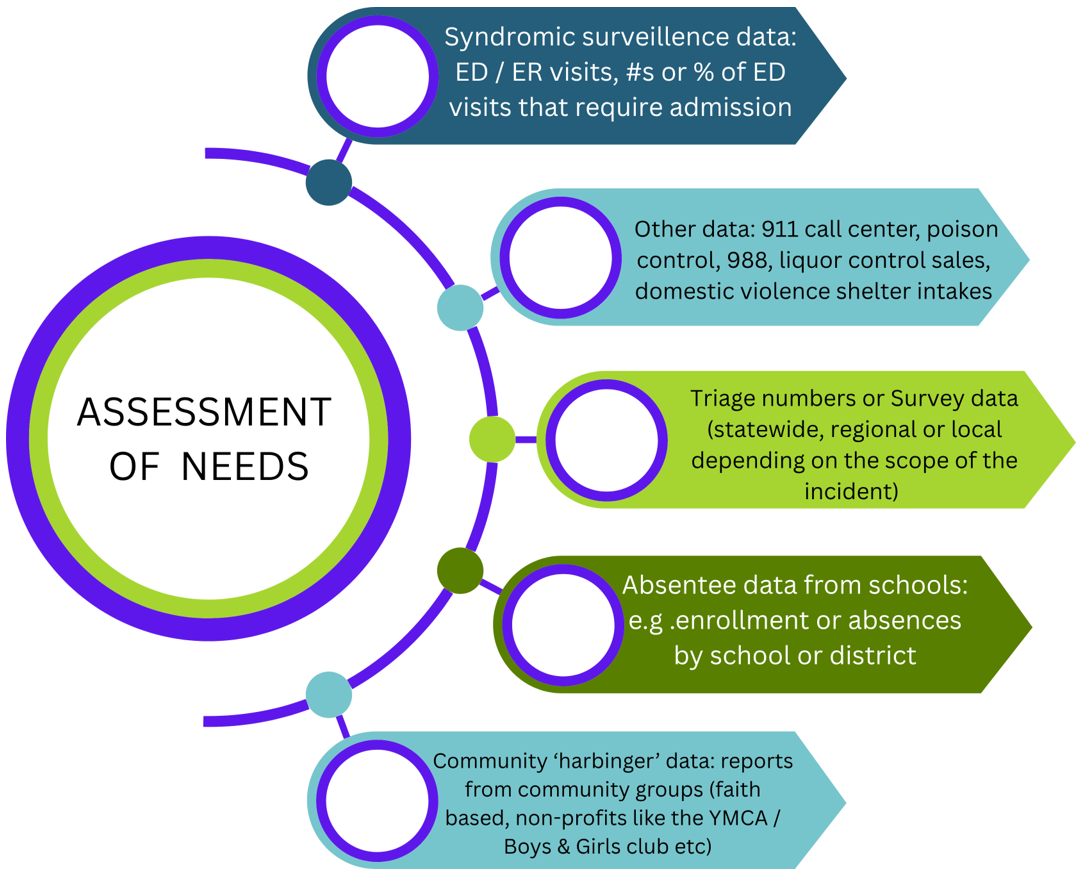
- Collect data on disaster specific behavioral health needs to inform the potential demands generated by the disaster. Using some, all, or any combination of available data sources and metrics. See Figure 14 below for an example of data sources and types.
- Review the PDBH Operational Overview Table, specifically the overview of the PDBH Situational Awareness function, for detailed recommendations on these strategies and supporting references.
- Establish a “living” document to track available resources that can be updated in real time as both individual and systemic supports change over time.
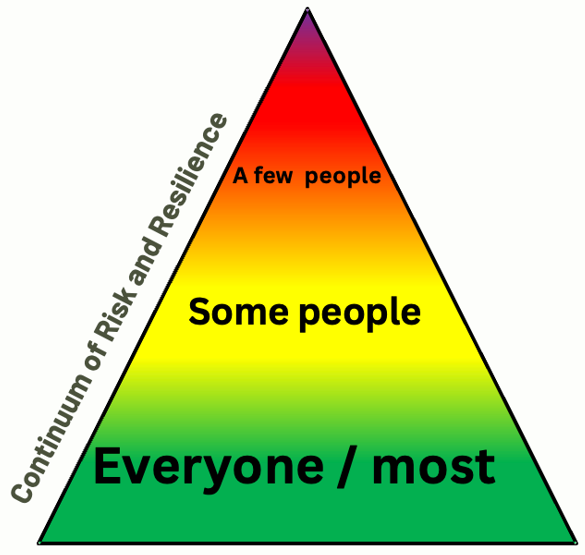
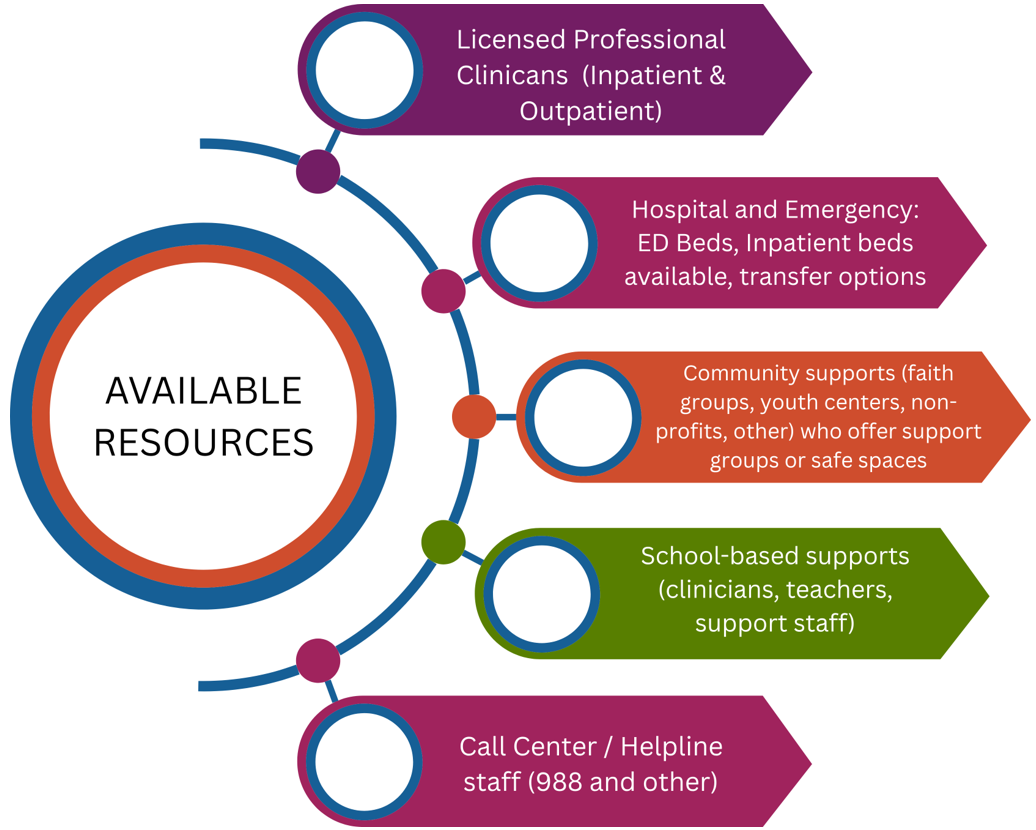
- Available resources should be considered on a spectrum based on the population needs triangle (Figure 15 below) and can include the examples identified in Figure 17. Resources for response and recovery include things such as professional clinicians in the area who are trained in TF-CBT, management of acute stress, PTSD, or other trauma related specialties (EMDR), as well as community or culturally based options for support.
- Please see Figure 16 for examples of how assessment data may be interpreted to inform the general number of patients in need of care. Please keep in mind that base-rate data is essential to have prior to the interpretation of any change related to prevalence of behavioral health disorder or diagnosis.
- Implement strategies to reduce barriers to care, expand capacity to provide care, or more effectively utilize existing resources (surge management.) Prioritize services that meet significant gaps based on assessments. Review the PDBH Operational Overview Table, specifically the overview of the PDBH Care function, for detailed recommendations on these strategies and supporting references.
FIGURE 14 : EXAMPLES OF ASSESSMENT OF DISASTER SPECIFIC NEEDS.
This chart includes some of the potential sources of data that can inform the clinical well-being within a population. This is not an exhaustive list. Unconventional data sources may become particularly useful as indicators of special or at-risk populations.
FIGURE 15: POPULATION BASED CONTINUUM OF RISK AND RESILIENCE
FIGURE 16: EXAMPLES OF DATA SOURCES AND CLINICAL INDICATIONS OR SUGGESTIONS
| Examples of data and clinical indications |
|
| Poison Control Data |
Dramtic increases in call volumne in a short time can indicate a spike in accuity for a
particular sub population (such as age) based on intentional or unintentional
ingestion. |
| Youth arrests or booking into criminal justice system |
Can indicate behavioral disruption, mental health symotom acuity, lack of parental
and caregiver oversight and support or availability. |
| Survey / Pulse data |
Indicates population level changes in prevalence rates for depression, anxiety and
both tor adults 18+ in specific geographic areas |
| Liquor control board and tax sates data |
Can indicate increases in baseline substance use (legal and illegal) |
| School absenteesim |
Could indicate that there are mental health, socio-economic or family/ domestic
issues that are preventing children and youth from attending school. |
FIGURE 17: AVAILABLE BEHAVIORAL HEALTH RESOURCE EXAMPLES
ADDITIONAL GUIDELINES
- Typically, local resources are immediately overwhelmed and will not be sufficient on their own for an effective long-term, large-scale recovery. The need to “bring in” external supports through response procedures is something that needs to be handled carefully and with respect for local processes, expertise, and experience.
- Behavioral health support is best when it comes from WITHIN an impacted community; people typically prefer to get help from others who know what things are like in their area, speak the same language (literally and metaphorically), and share cultural experiences or local understanding.
- Consider the addition of Just-In-Time (JIT) training for local clinicians or volunteers who don’t have a background in disaster behavioral health.
- New trainees should be informed about a) management of behavioral health ‘surge’, including altered implementation practices, b) the shift from individual to population level interventions, and c) crisis care standards.
- It is important when leveraging external resources that they do so with respect to local traditions, experts and norms, and that recommendations for support are appropriately tailored so as to be useful in the specific area (i.e. not suggesting telehealth when internet access is unavailable or inaccessible due to economic considerations; conversely, suggesting telehealth to increase access for rural communities when internet access is available).
- Traditional and cultural healing methods are recommended for inclusion by the APA and should not be excluded from response protocols.
- “Harbingers” of community mental health may come from unexpected sources. Listen to YMCA (or other nonprofit) staff, sports coaches and extracurricular leaders who have a strong sense of what is happening day-to-day with children in their community. They are often the first who can signal when needs shift or resources may be needed.
- Please see Phase-based Recommendations section for more information on need cadence and changes over time relative to phases of recovery.
EXAMPLE of CARE Process using steps outlined above
- Step 1: Establish base-rate data around the incident. What are the total numbers of clinicians available, and prevalence rates within the impacted population for things like depression, anxiety, and PTSD? How many children (and adults) are in close proximity to the event / incident?
- Step 2: Use psychological triage (e.g., PsySTART Victim Pediatric and Adult) to identify individual mental health risks among patients, families, and staff, and to estimate demand for services, then compare that demand against internal and community-based resources to identify gaps.
- Step 3: Using data from triage, conduct an initial projection of likely mental/behavioral health impacts among their patients, families, and staff (adult and pediatric), and evaluate these against known internal and referral capacity to identify gaps.
- Step 3 continued: Map available mental health resources (internal and external) along a continuum of care – from brief, low-intensity interventions to higher-acuity services – and align this with the facility’s role and community context.
- Step 3 continued: Consider both individual- and population-level strategies, such as: Trauma-Focused Cognitive Behavioral Therapy (TF-CBT) for children and youth identified as at risk for new mental health disorders (e.g., PTSD), particularly delivered in “stepped” format to increase access to care, and Psychological First Aid or Health Support Team training for health care staff and associated organizations.
EXAMPLE of CARE Process to estimate needs
WARNING:
- Your assumptions will likely be different.
- Your impacted population and mental health resources will be different.
- If you’ve seen one disaster, you’ve seen one disaster. Not all types of disasters have equal impacts.
- This is only one sample of a way to calculate the mental health impact and match to potential mental health resources.
- Your experience may vary.
EXAMPLE:
Assumptions
- Assume that you’ve conducted psychological triage across a variety of settings (hospitals, schools, field clinics, shelters.
- Assume that you’ve surveyed available mental health resources within your community.
- Assume that you’ve asked for additional resources outside the impacted area and have been told that there are none available at this time.
- Assume, based on triage scores of 3+, you have 100 children with significant trauma exposure warranting further evaluation and probably treatment.
- Assume, based on mental health resource surveys you have 50 mental health providers who see children and teens, and assume their current practices are full, but they might be willing and able to take on an additional 2 children each.
- Assume half of these providers are trained in “stepped” Trauma-Focused Cognitive Behavioral Therapy. The other half are trained in a variety of treatment modalities with less defined parameters.
Based on identified needs and gaps, your planning might go as follows
Refer children with the highest PsySTART scores for immediate secondary evaluation.
Once those children are engaged in care, create secondary tiers of children with fewer trauma exposures and have them put on provider waitlists, prioritizing highest triage scores to lowest. In the meantime, offer those children and families Psychological First Aid and psycho-education on impacts of trauma, along with information on how to identify emergencies such as suicidal thoughts and behaviors, psychosis, or other serious psychiatric emergencies and where to reach out in those cases. This support can be done by non-mental health providers who have received training in PFA.
Within the therapist group that are trained in a variety of trauma approaches, assume 15-20 sessions per child, delivered weekly. If half of the referrals go to this group of 25 providers, they could see 50 children through completed therapy in an estimated 20 session hours, or 5 months.
Within the therapist group trained in Stepped TF-CBT, expect that somewhere between 30% and 50% of children will be improved sufficiently for discharge after the first four modules (4-6 sessions, delivered over 4-6 weeks). Assuming half of the children are referred to these 25 providers, this provider group will be able to see 50 children within the range of 6 session hours for the 30% who rapidly improve, and 16 session hours for those requiring the full modules, or 6 weeks, to 4 months.