Text size
Line height
Text spacing
Children and adolescents admitted to an ITFC need nutritional stabilization, which is referred to as phase 1. During this stabilization phase, serious bacterial infections are diagnosed and treated as well as other medical complications. Any significant dehydration and or acidosis is corrected and metabolic functions are restored. During the transition to phase 2 when the child may be transferred to an ATFC, there is a gradual increase in calorie, protein, and osmolar load. The type of nutritional products used by Doctors without Borders, the targets for Kcal/kg/ day for children, adolescents, and adult, the meal frequency, and duration in the ITFC are shown in Table 13.
| Phase 1 - Stabilization | |
|---|---|
| Objective | To restore metabolic functions, stabilize, treat and/or prevent medical complications. |
| Product used | F75 |
| Quantities | 6 m-10 years 100 Kcal/kg/day (135 ml/kg/day) >10 y-18 yr 55 Kcal/kg/day (75 ml/kg/day) Adults and elderly 40 Kcal/kg/day (55 ml/kg/day) |
| Meal timetable | 8 meals a day Every 3 hours even at night. To adapt according to the context. |
| Duration | Minimum 3 days Maximum 7 days1 |
| Where | ITFC |
| Phase Transition | |
|---|---|
| Objective | To gradually ensure the patient can tolerate a higher calorie, protein and osmolar load before progressing to Phase 2 |
| Product used | RUTF (or F100) |
| Quantities | RUTF: 130 kcal/kg/day max F100: 6 m-10 years 135 Kcal/kg/day (135 ml/kg/day) >10 y-18 yr 75 Kcal/kg/day (75 ml/kg/day) Adults and elderly 40 Kcal/kg/day (55 ml/kg/day) |
| Meal timetable | 6 meals a day |
| Duration | 1-5 days (may be longer) |
| Where | ITFC |
| Phase 2 | |
|---|---|
| Objective | Intended to promote rapid weight gain and catch up growth. |
| Product used | RUTF and local meal |
| Quantities | RUTF: <6 kg: 2 sachets/day 6-10 kg: 3 sachets/day 10 kg: 4 sachets/day |
| Meal timetable | At home time meals |
| Duration | 4-6 weeks |
| Where | ATFC (home) |
For Kwashiorkor, the passage to transition will depend on the evolution of the edema. Causes of failure to respond (lack of loss of edema) should be daily assessed and measures should be taken.
Children and adolescents in nutritional phase 2 can be managed in an ATFC or if necessary at home. This phase focuses on promoting rapid weight gain and catch-up growth. The phase 2 targets for Kcal/kg/ day for children by their weight, the meal frequency, and duration are shown in Table 13.
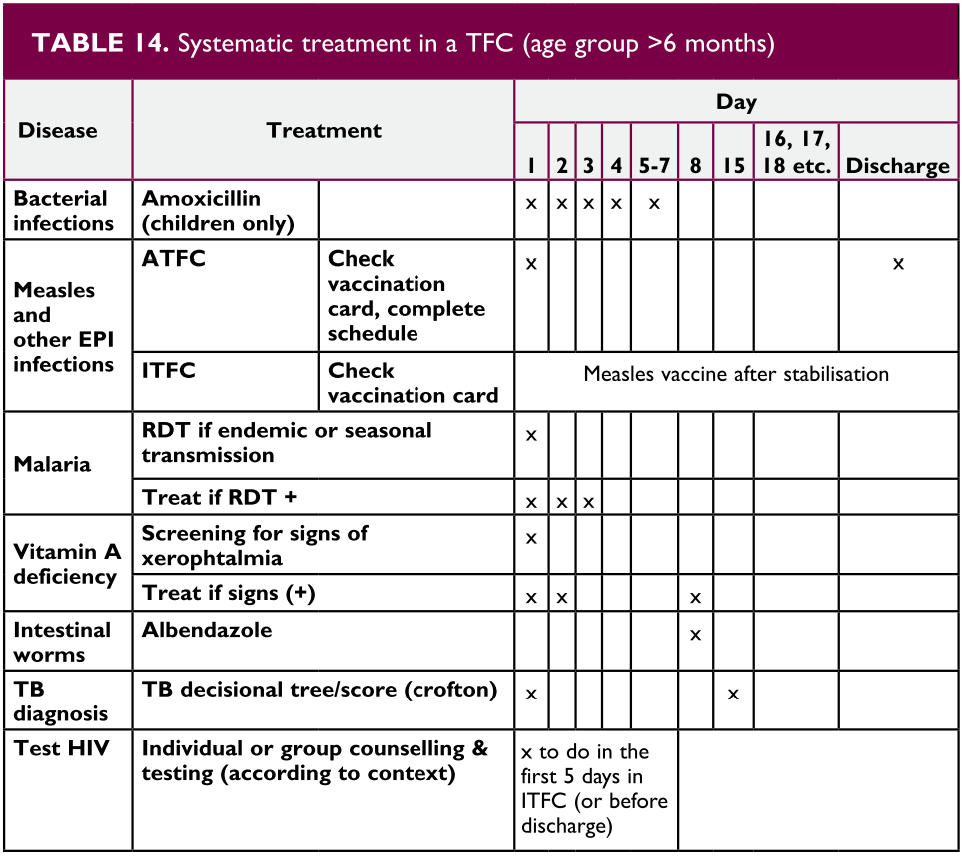
Medical management in a TFC used by Doctors without Borders is shown in Table 14. First line therapy for bacterial infection is amoxicillin. Immunization status is documented and if measles vaccination is not documented the child is immunized during the transition to nutritional phase 2. Vit A assessment includes screening for xeropthalmia and treatment if positive (<6 kg- 50,000IU, 6-8 kg 100,000 IU, and >8 kg 200,000IU).A rapid diagnostic test is done for malaria if malaria is endemic or has seasonal transmission and if positive treatment is begun. Children are treated for intestinal worms with albendazole on day 8. Children are also assessed for TB and HIV.