Text size
Line height
Text spacing
Poor respiratory effort, as manifested by apnea or gasping (deep, intermittent, slow, spasmodic inspiratory efforts), is the major indication to initiate neonatal resuscitation, and ventilation is the key to successful resuscitation. If the newborn does not rapidly establish effective spontaneous respiration, positive-pressure ventilation must be administered immediately.
The goal of positive-pressure ventilation is to inflate the lungs with an adequate breath. Inspirations that are too small will be ineffective for those in most need, and inspirations that are too large can damage the lungs. The effectiveness of ventilation can be judged as outlined in Box 3.
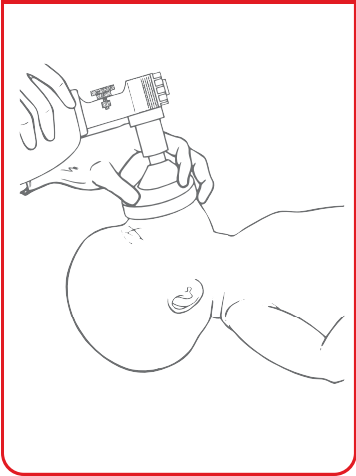
Many kinds of devices deliver positive-pressure ventilation for neo natal resuscitation. Flow-inflating bags, self-inflating bags, T-piece devices, oneway valve masks, and laryngeal masks are some of these devices. Most critical is the skill of the person who is operating any of these devices. Potential resuscitators should review the operation of the available devices, practice mock resuscitations, and test the operation of all bags, valves, connections, and safety features. Figure 4 illustrates the use of a self-inflating bag with a mask. The head is slightly extended. The mask covers the mouth and the nose. The fingers of the left hand lift the chin forward and upward and partially encircle the mask, placing light and even pressure downward onto the face to help create an adequate seal. The best indication of adequate lung inflation is the improvement in heart rate, color, and muscle tone.
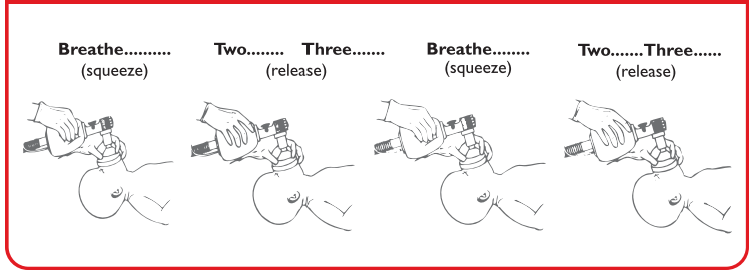
A good seal with the mask and good positioning are essential. The recommended ventilation rate is 40 to 60 breaths per minute as illustrated in Figure 5.
What if bag and mask ventilation is not effective?
If the patient is not improving, the most frequent cause is poor delivery of positive pressure. Failure to administer adequate positive pressure may be due to one of three common problems:
What if the requirement for bag and mask ventilation is prolonged?
The inflations might distend the stomach and interfere with ventilation. In this case, insert a small plastic or rubber catheter through the mouth, aspirate the stomach contents, and fix the open end of the tube to allow continuous drainage.
Ask an assistant to check the heart rate during positive-pressure ventilation or pause ventilation after 1 minute to check the heart rate if you are alone. The normal heart rate is greater than 100 beats per minute. The pulse at this time can be felt easiest at the base of the umbilical cord or can be heard with a stethoscope over the left side of the chest.
Neonatal resuscitation in the setting of an emergency or disaster is focused on providing effective ventilation. If the heart rate stays below 60 beats per minute even after improving positive-pressure ventilation by the steps above, advanced resuscitation may be indicated. Tracheal intubation, chest compressions, and medication administration can be provided when personnel and capability for acute and supportive care exist. For this reason, antenatal transport of preterm or high-risk term pregnancies to a center providing comprehensive emergency obstetric and neonatal care is preferable.
