Text size
Line height
Text spacing
The treatment of malaria depends on the likelihood of a malaria infection and the risk of chloroquine-resistant P. falciparum or P. vivax, the severity of the infection, the setting, and the availability of drugs. In high-risk areas, treat all forms of uncomplicated malaria not caused by Plasmodium falciparum with oral or nasogastric chloroquine phosphate (except for chloroquine-resistant parasites). Prima-quine is effective at preventing relapses because it eradicates the liver stages of P. vivax and P. ovale that persist in patients who have experienced the acute illness. This drug is not normally used in disaster situations.
In low-risk areas or areas with seasonal malaria, only treat children presenting with fever with no other identified cause (acute respiratory infection, ear infection, pharyngitis, measles, etc.). However, the persistence of fever longer than 5 days requires reassessment and, if possible, testing for malaria.
The management of all forms of Plasmodium falciparum now recommended by the WHO since 2008, given the incr easing resistance to chloroquine shown by these organisms, is a new first line therapy that replaces classical chloroquine phosphate: artemisininbased agents.
There are combination therapies and non-combination therapies, but the first are recommended. They are given orally for 3 days.
| 5-14 kg (<3 years) | |
|---|---|
| 0 h | 1 |
| 8 h | 1 |
| 24 h | 1 |
| 36 h | 1 |
| 48 h | 1 |
| 60 h | 1 |
| 15-24 kg (>3-8 years) | |
|---|---|
| 0 h | 2 |
| 8 h | 2 |
| 24 h | 2 |
| 36 h | 2 |
| 48 h | 2 |
| 60 h | 2 |
| 25-34 kg (>9-13 years) | |
|---|---|
| 0 h | 3 |
| 8 h | 3 |
| 24 h | 3 |
| 36 h | 3 |
| 48 h | 3 |
| 60 h | 3 |
| >34 kg (>14 years) | |
|---|---|
| 0 h | 4 |
| 8 h | 4 |
| 24 h | 4 |
| 36 h | 4 |
| 48 h | 4 |
| 60 h | 4 |
Adapted from: World Health Organization. Manual for the health care of children in humanitarian emergencies, 2008.
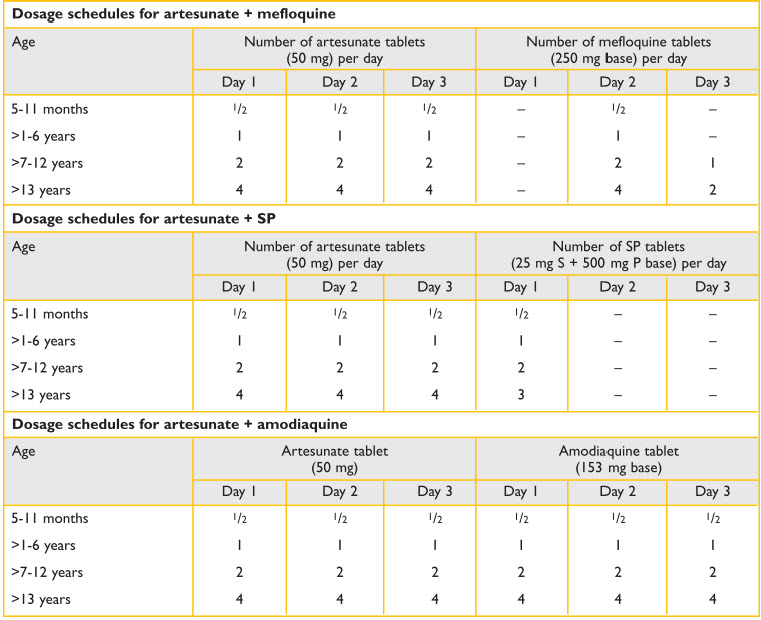
Adapted from: World Health Organization. Manual for the health care of children in humanitarian emergencies, 2008.
Chloroquine-resistant strains of P. falciparum are common throughout many regions of the world. When the proportion of chloroquine-resistant P. falciparum is less than 25%, it may be reasonable to use chloroquine as first-line treatment in less severe patients and assess the response. Failure to respond in 48 to 72 hours indicates infection with a resistant strain. Treat children with chloroquine resistant P. falciparum uncomplicated malaria with quinine sulfate 25 mg/kg/day tid for 3 to 7 days (depending on resistance patterns to quinine) plus one of the following:
Treat children who may have acquired malaria in Southeast Asia (Thailand) and East Africa with quinine for 7 days, because of the presence of multiple resistant strains in these areas. Additional alternative therapies for resistant P. falciparum include atovaquone-proguanil, mefloquine, halofantrine (associated with heart-related side effects), and artesunate. See appendix for Centers for Disease Control and Prevention (CDC) actual recommended treatment options.
Chloroquine is effective and safe for treating pregnant women. This is important because malaria during pregnancy is more severe and can be fatal. Ideally, use supervised therapy. Observe administration of at least the first dose to be sure that it is not vomited.
If chloroquine phosphate is not available, hydroxychloroquine sulfate is also effective, but in this case 400 mg of hydroxychloroquine are equivalent to 500 mg of chloroquine phosphate.
In several regions mixed infection with species of P. falciparum and P. vivax commonly occurs. If diagnosis of infection is based solely on clinical data, therapy must cover both types of parasites. In the acute phase of an emergency, the detection of a P. falciparum infection is a priority and artemisininbased agents (except artesunate SP) are effective against both organisms.
Supportive management of uncomplicated malaria includes antipyretics, oral rehydration solution (ORS), assessment, and possible referral to a feeding program for malnutrition. Successfully treated patients should improve by 48 hours and be symptom-free by 72 hours. If symptoms persist after 3 days, obtain a new blood smear and consider the possibility of chloroquine-resistant malaria or an alternative cause for the fever.
Assume that all severe, complicated malaria infections are caused by resistant P. falciparum strains unless proven otherwise. Children with severe, complicated malaria can deteriorate rapidly, so initiate treatment with the best available drug and, if possible, arrange a transfer to a hospital for intravenous (IV) therapy (see appendix).
First line (preferred treatment) is Artesunate parentral (IV/IM). In the absence of parenteral form of Artesunate, Artemether IM is acceptable. However, If the child is in shock second choice after artesunate is quinine over artemether.
Quinine is acceptable option but it requires attention to the proper dosage and administration with IV fluids. There is a loading dose and maintenance dose and care needs to be taken to prevent hypoglycemia
Administer rectal artesunate 10 mg/kg in a suppository. Repeat the dose if the drug is eliminated within the first hour. Repeat the dose in 24 hours if the patient can not be transferred to the hospital. Artesunate l suppositories remain stable at temperatures of up to 40 degrees and, therefore, require warm, not cold, temperatures for transportation and storage.
After IM or IV therapy, the patient should be switched to oral therapy; the recommended agent in this case is ar temetherlumenfratine (Coartem®) during three days.
If first-line drugs were unavailable, an option is quinine dihydrochloride. A loading dose of 20 mg/kg in 10 mL/kg of 5% dextrose should be administered IV over 4 hours, followed by 10 mg/kg over 4 hours (maximum 1,800 mg/kg) until oral therapy can be started (see Appendix). Blood glucose monitoring for hypoglycemia is recommended every 4 hours after each loading and maintenance infusion. If IV quinine is required for more than 48 hours, maintenance dose should be reduced to 7 mg/base/kg. It is extremely important to bear the infusion volume into account. In order to avoid volume overload due to the IV administration of liquid, the quinine infusion volume should be included in the estimation of daily liquid requirements.
Quinine can be diluted in 5% glucose solution, 10% glucose, 4% glucose, 0.18% saline or 0.9% normal saline. It should be diluted to a total volume of 10 mL/kg (the same volume should be used both for the loading dose and the maintenance dose) and infused over 4 hours. After a minimum of three IV doses of quinine, the patient should be switched to oral therapy. Therapy options by this route include: artemetherlumefantrine (Coartem®) over 3 days, or oral quinine 10 mg base/kg, every 8 hours, until a 7-day course is completed. In areas of multiple resistant malaria, quinine should be combined with oral clindamycin, 5 mg/kg 3 times a day, during 7 days. Mefloquine should be avoided in children that have been in coma, since it increases the risk of neuropsychiatric complications.
A third choice is administering an initial dose of quinine sulfate by oral route or nasogastric tube until IV therapy is available. If the patient vomits, repeat the dose within 30 minutes. If vomits persist, start IM quinidine 10 mg/kg every 4 hours until the patient is transferred to a hospital for IV therapy. At the hospital, treat very severely ill patients with an IV loading dose of quinine gluconate 10 mg/ kg administered over 1 to 2 hours, then with a 0.02 mg/kg/min continuous infusion until oral therapy can be given. If possible, measure hemoglobin, blood sugar, and perform blood and cerebrospinal fluid (CSF) cultures.
Treat children with severe complicated malaria with antibiotics for potential bacteremia or meningitis pending the results of blood and CSF cultures. If possible, monitor the patient for electrocardiographic changes (QT interval, arrhythmias), cinchonism (tinnitus, nausea, headache, and visual changes), and hypoglycemia. Discontinue IV quinidine as soon as the child has improved and switch to oral or nasogastric quinine to complete a 3 or 7 day course (varies by region).
Indications for exchange transfusion vary according to the quality of intensive care facilities and availability and safety of blood products. The theoretical benefits of an exchange transfusion are parasitemia reduction, correction of anemia, improved oxygenation, and enhanced capillary blood flow. It is recommended when children have signs of very severe illness with parasitemia >10%.
The underlying immunopathology of severe dengue infection involves host and viral factors and possibly sequential infections with different virus serotypes.
Supportive treatment of severe, complicated malaria includes antipyretics and oral rehydration solution (ORS). Monitor signs that suggest fluid overload causing pulmonary or cerebral edema. Initial treatment of seizures with at 2-4 mL/kg of dextrose 10% IV or oral 50% dextro, followed by phenobarbital (10 mg/kg IM) if seizures persist.
In seasonal highly endemic areas chemoprevention has been shown to be an effective strategy to reduce malaria epidemics and the incidence of new cases.
