Text size
Line height
Text spacing
The efficacy and safety of ORT have been proven worldwide. In 1964, the identification of the sodium-glucose cotransport system in the intestinal mucosa led to the development of different solutions for the oral treatment of dehydration. During the 1971 cholera outbreak in Bangladesh, mortality rates from diarrheal illness dropped from 25% to 3% when ORT was introduced instead of IV therapy. In the overwhelming majority of patients with diarrheal illness in a disaster, ORT is effective in preventing and treating the associated dehydration.
In normal physiologic status, water is absorbed osmotically across the small bowel through tight junctions between epithelial cells due to a sodium gradient that is maintained by 2 mechanisms of sodium absorption in the brush border membrane of the luminal cell: passive sodium/potassium diffusion and active cotransport of sodium jointly with monosaccharides such as glucose. The resulting intracellular sodium is then actively transported via ATPase carrier enzymes into the intercellular space, resulting in an osmotic gradient between the intercellular and luminal spaces, allowing for free diffusion of water (Figure 1).
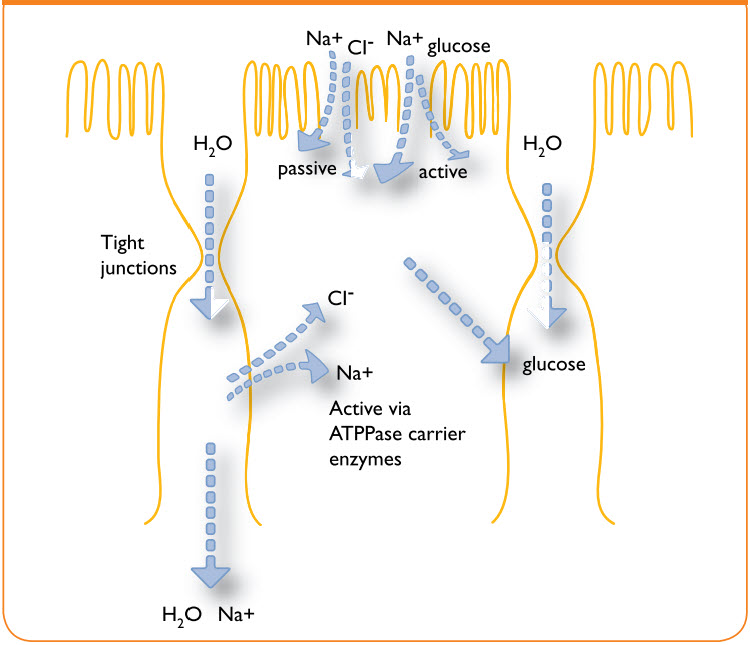
In diarrheal illness, the passive absorptive mechanism of sodium and chloride is impaired, but glucose absorption remains largely intact. This allows the absorption of enough water and sodium to compensate for fluid losses as significant as those seen in cholera. The osmotic gradient in the intercellular space maintains the absorption of potassium and bicarbonate. In this way, the metabolic acidosis usually associated with dehydration can be corrected without the risk of overcorrection.
Oral rehydration therapy has multiple advantages over parenteral rehydration (Box 1). Since ORT uses the normal physiologic mechanisms of intestinal absorption there is no risk of complications, such as water overload or overcorrection of electrolyte and acid-base disturbances associated with dehydration. Thus, ORT can be used in any dehydrated child, regardless of the type of dehydration. Moreover, laboratory tests are not usually necessary for the patient’s evaluation.
In the overwhelming majority of patients with diarrheal illness in a disaster, ORT is effective in preventing and treating the associated dehydration.
Normal hydration in children receiving ORT is usually achieved in 4 to 6 hours, allowing early refeeding, resulting in decreased risk of malnutrition associated with diarrheal disease.
Costs of ORT are minimal compared with those of IV therapy. Moreover, its major ingredients (salt, water, and sugar or starchy foods like rice) are often present in the community when premixed oral rehydration solutions (ORS) are not readily available. ORT is simple and can be given by trained health assistants. In addition, it requires the participation of the mother, thus encouraging family involvement in the child’s health. Because its requirements are minimal, ORT can be used at the site of the disaster, reducing the demands on medical hospitalbased personnel and allowing patients to be in close contact with their families (Box 2). Lastly, complications associated with invasive procedures, such as IV therapy, particularly infections, are totally avoided.
The most widely used formulation for oral rehydration is the one designed by the World Health Organization (WHO).
The most important feature of this solution is the inclusion of equimolar quantities of sodium and glucose, which enhances the intestinal absorption of both molecules. The solution also contains a source of bases (bicarbonate or citrate) and potassium (Box 3).
| Reduced osmolarity ORS | grams/litre | Reduced osmolarity ORS | mmol/litre |
|---|---|---|---|
| Sodium chloride | 2.6 | Sodium | 75 |
| Glucose, anhydrous | 13.5 | Chloride | 65 |
| Potassium chloride | 1.5 | Glucose, anhydrous | 75 |
| Trisodium citrate | Potassium | 20 | |
| dihydrate | 2.9 | Citrate | 10 |
| Total Osmolarity | 245 |
The reduced osmolarity ORS containing 75 mEq/l sodium, 75 mmol/l glucose (total osmolarity of 245 mOsm/l) is as effective as standard ORS in adults with cholera. However, it is associated with an increased incidence of transient, asymptomatic hyponatraemia. This reduced osmolarity ORS may be used in place of standard ORS for treating adults with cholera, but careful monitoring is advised to better assess the risk, if any, of symptomatic hyponatraemia. Because of the improved effectiveness of reduced osmolarity ORS solution, especially for children with acute, non-cholera diarrhoea, WHO and UNICEF now recommend that countries use and manufacture this formulation in place of the previously recommended ORS solution with a total osmolarity of 311 mOsm/l.
Despite initial concerns for hypernatremia associated to the use of the WHO solution, particularly in hypertonic dehydration, the ORS has been proven to be efficacious and safe, regardless the patient’s serum sodium.
Oral rehydration therapy involves no risk of complications, such as water overload or overcorrection of the electrolyte and acid-base disturbances associated with diarrheal dehydration.
The WHO ORS does not reduce the duration or intensity of diarrhea. For this reason, research has focused on alternative formulations with different components, such as the use of amino acids as cotransporting molecules; solutions derived from cooked cereals, usually ricebased; and glucose-based ORS with lower osmolarity. Amino acid-based formulations have not been proven significantly beneficial. Rice-based formulations have demonstrated improved efficacy in patients with cholera. They may be used in situations where rice is readily available.
WHO has recently recommended the use of hypoosmolar solution, particularly for children with acute, non-cholera diarrhea.
A number of studies have demonstrated that lowering the concentrations of glucose and sodium to a total osmolarity of 245 mOsm/L can decrease stool output and vomiting in children with acute noncholera diarrhea, without significantly compromising efficacy in cholera patients. Based on these findings, the WHO has recently recommended the use of hypoosmolar solution, particularly for children with acute, non-cholera diarrhea.
In situations where prepackaged ORS is not available, rehydration can be performed with different extemporaneous solutions. The simplest requires rice, water, and salt. One hundred grams of rice is cooked in 1 liter of boiling water for 10 minutes or until the rice pops. The water is then drained from the rice into a container, and any remaining water is squeezed from the rice with a spoon. When all the water is squeezed from the rice, enough water is added to the solution to bring the total volume to 1 liter and 1 pinch of salt is added.
Use only drinking water to prepare rehydration solutions. Any other beverage (such as mineral water or carbonated beverages) will modify the concentrations of the various components and consequently reduce its efficacy. Ideally, once prepared, keep solutions refrigerated. Discard any unused solution 24 hours after preparation.
Contraindications for ORT are listed in (Box 4). The presence of other severe disease, such as sepsis or meningitis, also contraindicates the use of ORT, but vomiting before or during ORT is not a contraindication. Only untreatable vomiting will require parenteral therapy.
The presence of severe hemodynamic disturbances prompts immediate IV fluid replacement. However, if no supplies are available, perform ORT until IV treatment is possible.
Before starting ORT, auscultate the abdomen to check for the presence of bowel sounds and rule out a diarrhearelated ileus (severe hypokalemia, antispasmodic-drug toxicity).
