Pediatric Behavioral Health in Disasters
1. Introduction
Welcome to the Pediatric Behavioral Health in Disasters curriculum. The content presented follows the four phases identified in the disaster management cycle: Preparedness, Response, Recovery, and Mitigation. This four-chapter curriculum is designed to be a primer in disaster mental health.
Each chapter features three articles with associated knowledge checks and will take approximately one hour to complete. The articles provide an overview of key concepts and resources, with case examples to illustrate the implementation of psychosocial approaches and interventions. Learners will receive guidance in providing just-in-time intervention, identifying opportunities for professional growth, and taking actionable steps to improve everyday readiness. Continuing education credit is available for each chapter upon completion of its required components.
Published in January 2025 in Pediatrics, the State-of-the-Art Review, Supporting Children's Mental Health Needs in Disasters, summarizes the available evidence for the integration of behavioral health into the disaster phases, with consideration of promoting equity in mental health and identifying strategies and gaps in addressing pediatric mental health in disasters. This article serves as a framework for how healthcare systems can address children’s developmental, behavioral, social, and emotional needs in the context of disasters.
What You’ll Learn
- Identify key principles that should be considered when selecting screening instruments, delivering care, and assessing and measuring change that is consistent with a trauma-informed system of care
- Describe the presentation and typical trajectory of posttraumatic stress symptoms in children and adolescents experiencing a catastrophic event
- Describe application of psychosocial interventions that can be delivered in the immediate aftermath of a disaster as well as during response and recovery.
Curriculum Outline
Preparedness
I. Trauma: Risk Factors, Presentation, and Effects
II. Implementation of Psychological First Aid (PFA)
III. Ensuring the Safety of Children with Special Health Care Needs and Disabilities (CYSHCN) During Disasters
Response
I. A Trauma-Informed Approach to Supporting Survivors of Community Violence in a Hospital Setting
II. How to Support Resilience in Infants and Young Children Following a Catastrophic Event
III. Implementation of Skills for Psychological Recovery
Recovery
I. Taking the Fear out of Children’s Dreams Following a Disaster: The Wonder of Imagery Rehearsal Therapy
II. Cognitive-Behavioral Therapy for Insomnia: Using the Science of Sleep to Guide Treatment
III. Trauma-Focused Cognitive Behavioral Therapy in Response to a Disaster
Mitigation
I. Trauma-Informed Systems of Care
II. Risks and Mitigation of Secondary Trauma
III. Catastrophic Events: Behavioral Health Considerations in the Medical Home
Navigation
This chapter book is designed to allow you to reference content at your own pace with an option to check your knowledge and earn a CE certificate at the end of each chapter.
This content is available as a digital book in two formats:
1) Website, which you are currently reading. This format offers a mobile friendly multimedia experience with sharable links to chapters. There are three ways to move through the book:
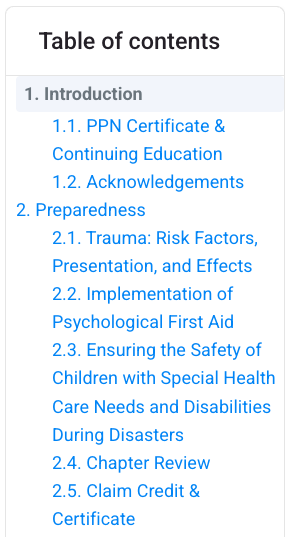
a) Use the table of contents chapter navigation to the left to navigate to different chapters in the book. Scroll through the links to select the chapter that interests you.
b) Use the yellow arrows that appear when scrolling to select previous and next chapters.

c) Use the previous chapter and next chapter buttons at the bottom of very page to navigate through the book.

2) Printable, which you can save as a PDF and open without an Internet connection.