Text size
Line height
Text spacing
Mass casualty management, as may occur in a disaster situation, requires an adjustment of the traditional emergency care approach. In the traditional care approach, first responders are trained to provide victims with basic triage and health-care before evacuation to the nearest available receiving health-care facility. This approach juxtaposes two organizations that work independently with only weak linkages: the field (often involving non health sector responders), and the receiving health-care organization that is often totally divorced from the pre-hospital problem. In a mass casualty situation, this approach will quickly result in chaos. For this reason, a system that would allow an adequate response to mass casualty situations was developed.
A school bus with primary school students and caregivers leaves for a drive into the countryside, but skids on a sinuous stretch of the road and overturns. The vehicle is seriously damaged. Several children and adults manage to escape, and many remain trapped inside. Children are screaming and crying.
This system, known as mass casualty management, includes pre-established procedures for resource mobilization, field management, and hospital reception. It is based on specific training of various levels of responders and incorporates links between field and health-care facilities through a command post. It acknowledges the need for a multi-sector response for triage, field stabilization, and evacuation to adapted health-care facilities. The development of this approach is based on the availability of large amounts of human and material resources, so it should be adapted to the available resources to maintain the same effectiveness in its implementation.
The rescue chain, the essence of the mass casualty management system, involves the health department, private hospitals, police, fire department, nongovernmental organizations (NGOs), transport services, and communications (Figure 3). This chain starts at the disaster site (with activities such as initial assessment, command and control, search and rescue, field care), continues with transfer of victims to appropriate facilities (using procedures to regulate evacuation and ambulance traffic control), passes through hospital reception (with activation of the hospital disaster response plan), and ends only when the victims have received all emergency care needed to stabilize them.
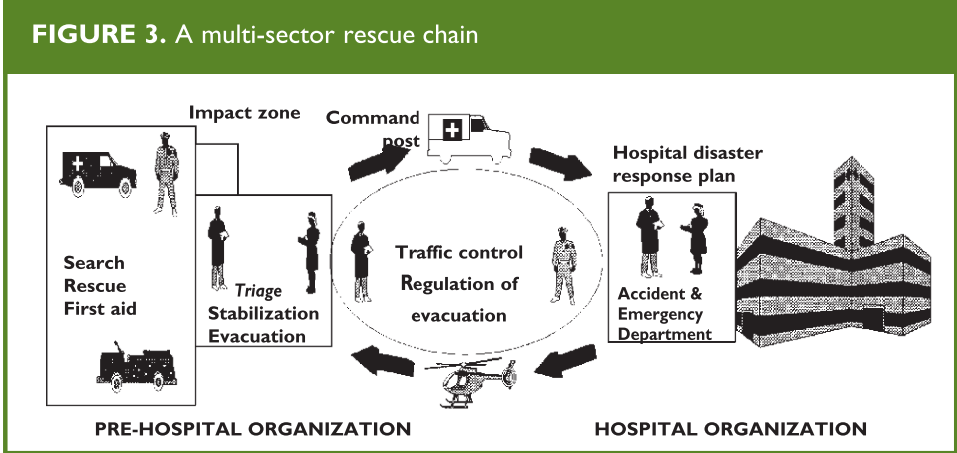
From: Establishing a Mass Casualty Management System, Washington D.C., 1996.
The implementation of this rescue chain requires the following components:
The assignment and organization of resources in mass casualty management requires careful planning.
As in any chain, the strength and reliability of the system depends on each link; if one fails, the entire system will be compromised.
