The Emotional Impact of Disaster on Children and Families
5. Specific Interventions
Objectives
- Describe the different types of interventions for emotional responses seen in children at differing developmental stages.
- Be aware of recommendations to restore routines and child and family functioning.
- Be acquainted with the possible interventions aimed at lessening the emotional impact of disasters childhood.
Case 1
An important part of the population in your city has been affected by a flood, prompting an evacuation plan that involves displacement of most people to shelters. You have been summoned as part of the multidisciplinary rescue teams.
- As a pediatrician, what do you consider to be your role in helping families during the first days?
Case 2
After an earthquake the population of your town is progressively returning to normal. Children are gradually returning to school.
- What do you think should be your role in this phase regarding school and school teachers?
MHPSS Intervention Pyramid
The intervention pyramid represents the interagency consensus around mental health and psychosocial support in humanitarian emergencies as enshrined in the IASC Guidelines for Mental Health and Psychosocial Support in Emergency Settings (2007), and has been endorsed by the major organizations involved in the humanitarian response including United Nations Agencies such as the World Health Organization, UNICEF and UNHCR, and international organization such as the International Federation of Red Cross and Red Crescent Societies, The International Committee of the Red Cross, the International Organization for Migration, and major non nongovernmental organization such as Save the Children, CARE, War Child etc.
It outlines the importance of differentiating specific layers of interventions and supports adapted to different groups. Preventive interventions as well as initiatives that restore safety and a sense of normalcy are complementary to clinical support. This multi-layered framework highlights the need for services to be integrated and holistic. It is not possible for one agency to implement all levels of the pyramid and all levels might not be required at all stages of the displacement cycle or emergency. The layers are not mutually exclusive, so a child that receives support on layer 4 will also need the supports of layer 3, 2 and 1. The conceptual model fosters collaboration and encourages participatory approaches in which the agency of survivors of disasters is promoted.
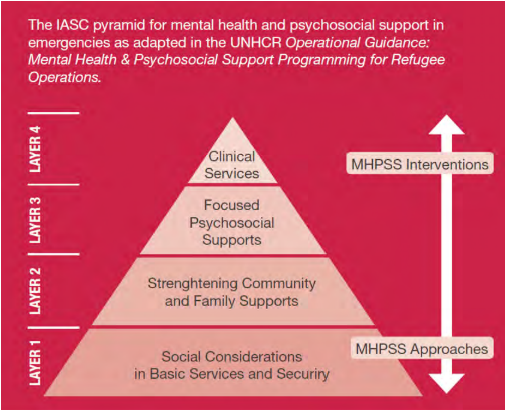
- LAYER 4. CLINICAL SERVICES and professional mental health support for children under significant distress that disrupts their ability to function on a day-to-day basis. Interventions at this level should be undertaken by specialized mental health professionals and the treatment (e.g. counselling or psychotherapy) is often more long-term and should not be disrupted. It is done via individual case management it is preferable to keep the child on site as long as
- LAYER 3. FOCUSED PSYCHOSOCIAL SUPPORT is specific assistance provided to children at risk of developing mental disorders. Interventions are not specialized, but should be undertaken by staff with significant training and supervision. Examples could be support groups, peer-to-peer support programs, and structured sessions aimed at strengthening resilience.
- LAYER 2. STRENGTHENING FAMILIES’ AND COMMUNITIES’ ABILITY TO SUPPORT children’s learning and development. It is important to promote everyday activities such as attending play and social activities, going to school and options of participation in traditional and community events. Interventions could include child friendly spaces, support for family tracing and reunification, and other family, peer and community support initiatives.
- LAYER 1. SOCIAL CONSIDERATIONS IN BASIC SERVICES AND SECURITY implies ensuring or advocating for basic services to be functional and accessible to children and their caregivers. Important activities are re-establishing a sense of safety, ensuring basic services such as water, food and shelter, and access to health services for the whole community, including child-friendly information on where to go for help. This should take into account ‘hard to reach’ categories of children such as adolescent girls, younger children and children with disabilities. This work represents a general approach carried out by all humanitarian workers.