Management of Prevalent Infections in Children Following a Disaster
9. Vaccination in Disaster Situations
9.1. Guidelines for Evaluation and Management of a Meningococcal Disease Outbreak
1. Reinforcement of active surveillance
In areas where surveillance for meningococcal disease is passive, case reports may be incomplete or delayed. When an outbreak is suspected, alert public health authorities and request immediate report of new cases.
2. Case detection and bacteriologic confirmation
Establish the diagnosis of meningococcal disease considering confirmed, presumptive, or probable cases:
- Confirmed case: isolation of N. meningitides from a usually sterile site (blood, CSF) in an individual with clinically consistent findings.
- Presumptive case: observation of Gram-negative diplococci in any usually sterile site, with negative cultures and symptoms of disease.
- Probable case: positive antigen test for N. meningitidis (latex agglutination test, immunoelectrophoresis), with negative cultures and consistent symptoms.
Information about serogroup is essential. Laboratories not performing this test routinely should forward the sample to referral laboratories of higher complexity to identify the serogroup. If possible, investigate N. meningitidis subtype by pulsedfield gel electrophoresis or multilocus enzyme electrophoresis to determine if the strains of a group of cases are interrelated and whether they represent an outbreak.
Co-primary case:
Case occurring in a close contact within 24 hours of the onset of the disease in the primary case
3. Appropriate treatment of patients, according to management guidelines
4. Chemoprophylaxis and careful observation of contacts
Chemoprophylaxis and careful observation are recommended for close contacts. Chemoprophylaxis for individuals who are not close contacts is ineffective in preventing community outbreaks; therefore, it is not recommended. Exposed individuals must be carefully monitored and evaluated in case of any febrile illness.
5. Investigation of relationships between cases
In addition to demographics, obtain the following information for each affected individual: history of close contact with another primary case; participation in social activities or sports; attendance at child care centers, kindergartens, schools, universities, or clubs. This information will help identify cases as co-primary or secondary, reveal relationships between cases, and define the population at risk.
6. Assessment of the relationship of the suspected outbreak with the community or with an institution or organization
7. Definition of at-risk population
In outbreaks related to an institution or organization, cases are linked with a shared affiliation, such as attending the same day care center, kindergarten, school, or university or belonging to the same sports team. In such cases, the population at risk is everyone in those places. On the other hand, in community outbreaks patients do not share an affiliation, only a geographically defined location, such as a neighborhood, small town, city, or country. The risk group includes every individual living in those places.
8. Estimation of attack rate
Attack rate can be estimated by the following formula:
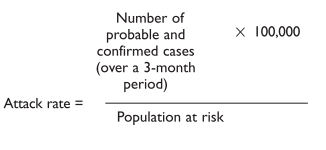
With a global attack rate higher than 10 cases in 100,000, consider vaccination of at-risk population. Consider the incidence rates by age groups. If the incidence rate doubles in a population with adequate epidemiological sur veillance, immunization may be considered.
9. Selection of the target group for vaccination
Consider the guidelines from public health authorities regarding the serogroup involved and the age group affected. In that case, it is necessary to have adequate vaccine supplies.