Disasters and their Effects on the Population: Key Concepts
3. Definitions
3.1. Classification of disasters
Types of Disasters
Disasters can be divided into 2 large categories (Box 2):
- Those caused by natural forces.
- Those caused by man.
Box 2: Types of disasters
Natural disasters
- Hurricanes or cyclones
- Tornadoes
- Floods
- Avalanches and mud slides
- Tsunamis
- Hailstorms
- Droughts
- Forest fires
- Earthquakes
- Epidemics
Man-provoked disasters
Technological/industrial disasters
- Leaks of hazardous materials
- Accidental explosions
- Bridge or road collapses, or vehicle collisions
- Power cuts
Terrorism/International violence
- Bombs or explosions
- Release of chemical materials
- Release of biological agents
- Release of radioactive agents
- Multiple or massive shootings
- Mutinies
- Intentional fires
Complex emergencies
- Conflicts or wars
- Genocide
Modified from Lou Romig, Disaster Management, in APLS, 4TH Edition, J&B Publishers, 2004
Natural disasters
Natural disasters are caused by natural forces such as earthquakes, volcanic eruptions, hurricanes, fires, tornadoes, and extreme temperatures.
They can be classified as rapid-onset disasters, such as earthquakes or tsunamis, and those with progressive onset, such as droughts that may lead to famine.
These events, usually sudden, can have tremendous effects. For instance, in November 2013, more than 6,000 people died and over 4 million were displaced in the Philippines as a result of Typhoon Haiyan.
Usually, a great number of persons die when a complex humanitarian emergency occurs
Since it is still extremely difficult to precisely predict the climatic and geological changes capable of causing a disaster, preparing for these types of events remains a major challenge.
Great natural disasters have also occurred recently throughout the world. (Box 3).
BOX 3. Natural disasters in the Americas in 2013
Heat Waves
Bolivia (August 2013): 17,490 people affected; 18 deaths
Earthquakes
Colombia (September 2013): 3,957 people affected
Peru (September 2013): 7,084 people affected
Epidemics
Costa Rica (July 2013, viral outbreak): 1,200 people affected; 3 deaths
Guatemala (August 2013, viral outbreak): 1,977 people affected; 8 deaths
Floods
Argentina (July 2013): 350,000 people affected; 52 deaths
Bolivia (February 2013): 145,000 people affected; 25 deaths
Brazil (January 2013): 200,000 people affected; 4 deaths
Peru (February 2013): 180,766 people affected; 67 deaths
Volcanic Eruptions
El Salvador (December 2013): 63,079 people affected
Tornado
USA – Oklahoma City (May 2013): 370 injured; 26 deaths
Modified from EM-DAT The International Disaster Database
The inability to accurately predict these types of events underscores the need for countries to have disaster response plans to mobilize appropriate resources rapidly and efficiently. A well-defined organizational structure must also be created to coordinate both national and international assistance.
Although significant progress in sanitation and disaster response has been achieved in certain regions of the world, developing countries continue to be highly vulnerable because of their fragile economies and limited healthcare and transportation infrastructure.
Man-made disasters
Disasters caused by humans are those in which the major direct causes are identifiable as intentional or unintentional human actions. They can be subdivided into three main categories:
Technological disasters
Unregulated industrialization and inadequate safety standards increase the risk of industrial disasters. Examples include the radioactive leak at the Chernobyl nuclear power plant in Ukraine (1986) and the toxic gas leak at a factory in Bhopal, India (1984). Both of these disasters were associated not only with many deaths but also with long-term health effects in the affected population.
Terrorism/Violence
The threat of terrorism has increased due to the spread of technologies involving nuclear, biological, and chemical agents used to develop weapons of mass destruction. Too often, the professionals who must respond to such disasters are not adequately trained, although several national and international organizations are developing training programs for these types of events.
Complex humanitarian emergencies
The term complex emergency is usually used to describe the humanitarian emergency resulting from an international or civil war. In such situations, large numbers of people are displaced from their homes because of the lack of personal safety and the disruption of basic infrastructure, including food distribution, water, electricity, and sanitation. In other cases, communities are left stranded and isolated in their own homes, unable to access assistance.
These settings are often characterized by a breakdown in social and physical infrastructure, including healthcare systems. Any emergency response usually has to be implemented in a difficult political and security environment.
There has been a global increase in civil war fueled by ethnic confrontations since the mid-1990s (Figure 2). In modern conflicts, the greatest loss of life (90%) occurs among civilian non-combatants because of direct physical injury and the public health impact of war (Figure 3).
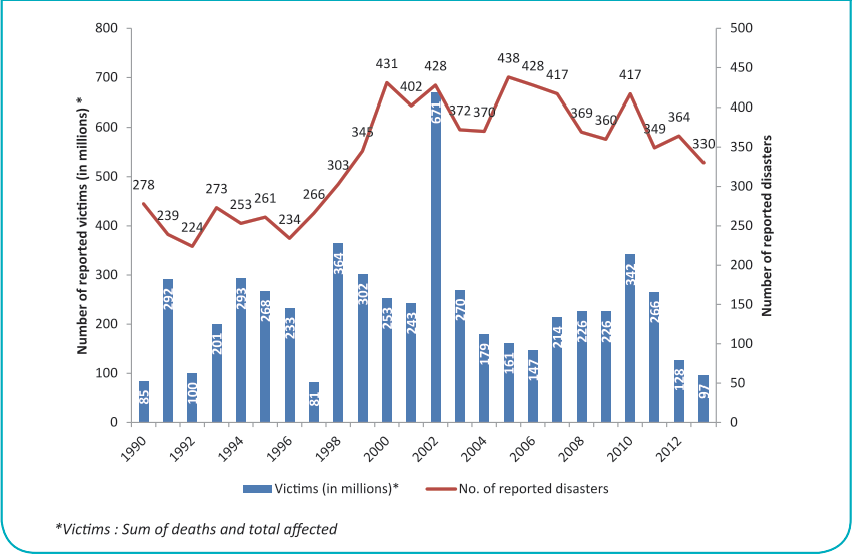
Source: “Annual Disaster Statistical Review 2013: The numbers and trends.” Debarati Guha-Sapir, Philippe Hoyois and Regina Below http://reliefweb.int/sites/reliefweb.int/files/resources/ADSR_2013.pdf
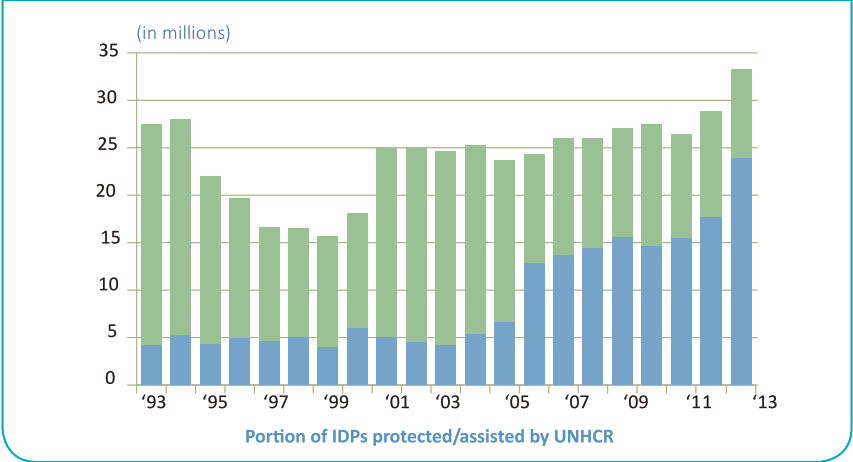
Source: “War’s Human Cost.” UNHCR Global Trends 2013. http://www.unhcr.org/5399a14f9.html
Complex humanitarian emergencies often result in a staggering loss of life. Table 1 shows the estimated excess deaths among civilians in several recent and ongoing crises.
| Country | Deaths | Period |
|---|---|---|
| Sudan | Over 1 million | 1983 to date |
| Rwanda | 500,000–1 million | 1994 to date |
| Cambodia | Over 1 million | 1975–1993 |
| Bosnia-Herzegovina | 200,000 | 1992–1996 |
Displaced Populations
Natural disasters and complex emergencies can force many people to leave their homes. The primary purpose of the United Nations High Commissioner for Refugees (UNHCR) is to safeguard the rights and well-being of people who have been forced to flee, including the right to seek asylum and find safe refuge in another country. Refugees and internally displaced persons (IDPs) are among the categories of people that UNHCR assists.
Refugees flee their countries because of war, violence, famine, or a well-founded fear of persecution for political, ethnic, religious, or nationality-related reasons. According to 2015 UNHCR estimates, there are 21.3 million refugees and 10 million stateless people (Figure 5). A person recognized as a refugee is entitled to certain protections under the terms of international humanitarian law.
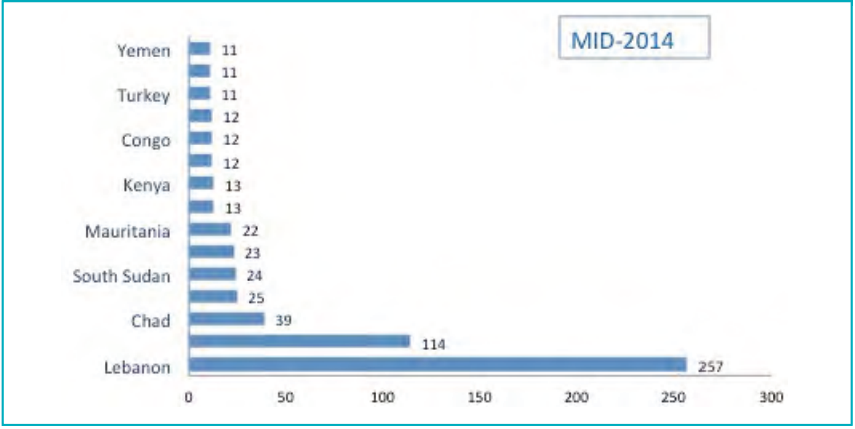
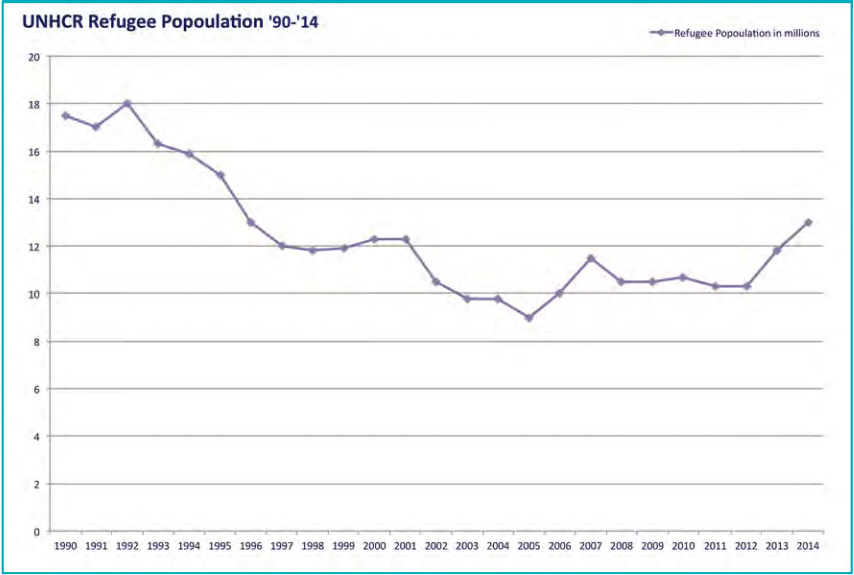
Internally displaced persons (IDPs) leave their homes for similar reasons but do not cross the boundaries of their countries. These individuals do not receive the same kind of legal protection, which can make assisting them more difficult. According to the 2015 Internal Displacement Monitoring Centre, there are 65.3 million displaced people.
More information is available at: